Few things are as stressful as the “financial blindspot”—that moment of panic when you realize a major annual expense is due, or you discover that your monthly savings have mysteriously vanished. Whether you are managing a household, a freelance business, or a growing corporation, the chaos of unpredictable spending is the enemy of growth. This is where a comprehensive annual budget sheet becomes your most powerful tool. Rather than looking at your money through a narrow 30-day window, an annual budget sheet provides a panoramic view of your financial health, allowing you to anticipate lean months and capitalize on windfalls before they are spent impulsively.
The Strategic Advantage: Why an Annual Budget Sheet is Non-Negotiable
Most people stop at a monthly budget. While monthly tracking is great for discipline, it fails to account for the “lumpy” nature of real-world finances. Taxes, insurance premiums, holiday spending, and annual subscriptions don’t happen every month, but they can devastate a monthly budget if not planned for in advance.
Implementing a dedicated annual budget sheet transforms your relationship with money from reactive to proactive. Here is the hidden value this document provides:
- Variance Analysis: By tracking your “Planned” vs. “Actual” spending over twelve months, you can identify patterns. If you consistently overspend on utilities in July, you can adjust your future forecasts with surgical precision.
- Sinking Fund Integration: An annual view allows you to implement “sinking funds”—setting aside small amounts monthly for a large year-end expense, ensuring you never have to rely on high-interest credit cards.
- Psychological Security: There is a profound mental shift that occurs when you know exactly where every dollar is going for the next 365 days. This reduces financial anxiety and allows for more confident decision-making.
- Goal Alignment: When you see the year in totality, it becomes easier to allocate funds toward high-impact goals, such as a house down payment or a retirement portfolio, rather than letting “leakage” erode your wealth.
Anatomy of a Perfect Annual Budget Sheet
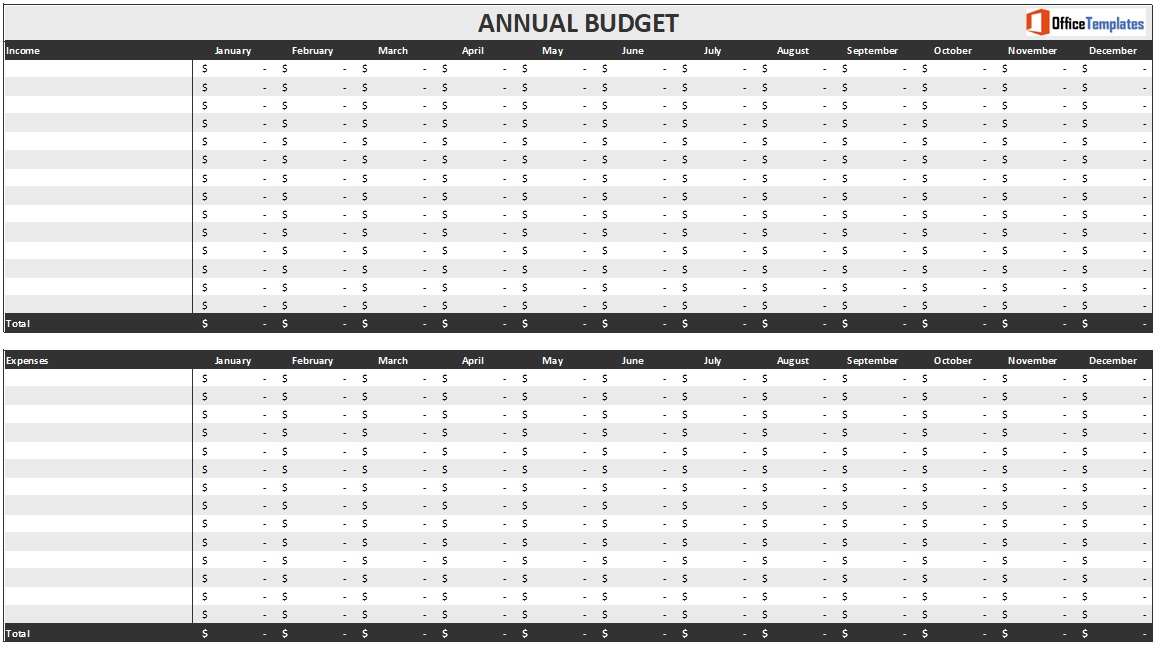
A high-performing annual budget sheet is more than just a list of numbers; it is a financial map. To be effective, your sheet must be divided into logical segments that separate fixed obligations from variable desires. If you are building your own or evaluating a template, ensure it contains these essential components:
1. The Income Ledger
This section should track all revenue streams. Do not just list your base salary; include:
- Primary Income: Monthly take-home pay after taxes.
- Variable Income: Bonuses, dividends, freelance side-hustles, or tax refunds.
- Passive Income: Rental income or interest from high-yield savings accounts.
2. Fixed Expenses (The “Non-Negotiables”)
These are costs that rarely change month-to-month. Having these clearly delineated prevents “budget shock.”
- Housing: Rent/Mortgage, HOA fees, and property taxes.
- Utilities: Internet, phone, and basic electricity/water.
- Insurance: Life, health, and auto premiums.
- Debt Obligations: Minimum payments on student loans or car notes.
3. Variable Expenses (The “Flexible Zone”)
This is where most budgets fail. A professional sheet breaks these down into granular categories to identify waste:
- Lifestyle: Groceries, dining out, and entertainment.
- Wellness: Gym memberships, healthcare co-pays, and pharmacy costs.
- Transport: Fuel, ride-shares, and general vehicle maintenance.
4. The “Annual Spike” Column
A dedicated section for non-monthly costs, such as annual software subscriptions, holiday gifts, or quarterly car registration. This ensures these costs are amortized across the year.
5. Summary Metrics (The Dashboard)
At the bottom or top of the sheet, include automatic calculations for Net Cash Flow (Income minus Expenses) and Savings Rate (Percentage of income saved).
Download Free Annual Budget Sheet

Step-by-Step Guide: How to Customize and Use Your Annual Budget Sheet
Owning a template is only 10% of the battle; the remaining 90% is the execution. Follow this chronological workflow to turn your annual budget sheet into a living financial document.
- The Historical Audit (Month 1): Before projecting the future, look at the past. Review the last 12 months of bank statements. Categorize every expense to determine your actual average spending. This prevents you from setting unrealistic goals.
- Set Your “North Star” Goals: Decide what you want to achieve by the end of the fiscal year. Whether it’s saving $10,000 or paying off a specific credit card, enter these as “Target Goals” at the top of your sheet.
- Map the Fixed Costs: Fill in your known constants first. These are the easiest to track and provide the baseline for how much “disposable” income you actually have.
- Allocate via Zero-Based Budgeting: Assign every single dollar a job. If you have $500 left over after expenses, don’t leave it as “Extra.” Assign it to “Emergency Fund” or “Investment Account.” If the balance is zero, you have a complete plan.
- The Monthly Reconciliation Ritual: On the first weekend of every month, enter your actual spending into the sheet. Compare it to your projected spending. If you overspent in “Dining Out” in March, subtract that amount from your April allowance to stay on track for the year.
- Quarterly Calibration: Every three months, review your progress. Adjust for inflation, salary raises, or changes in lifestyle. An annual budget is a guide, not a prison; it should evolve as your life does.
Best Practices & Common Mistakes to Avoid
To maximize the efficiency of your annual budget sheet, avoid the common pitfalls that lead many to abandon their budgeting efforts by February.
Pro-Tips for Success:
- Automate the Data: Use Google Sheets or Excel with formulas (like
=SUMand=VLOOKUP) to automatically calculate totals. Manual addition is a recipe for errors. - Use Color Coding: Use conditional formatting. Set cells to turn red if “Actual” exceeds “Planned” and green if you are under budget. This provides an immediate visual health check.
- The 10% Buffer: Always include a “Miscellaneous” line item totaling about 5-10% of your budget. Unexpected costs will happen; planning for them prevents the budget from breaking.
Common Pitfalls:
- Over-Categorization: Don’t create a separate category for “Lattes,” “Bagels,” and “Tea.” Group them under “Café/Dining.” Too much detail leads to tracking fatigue.
- The “Set and Forget” Mentality: A budget sheet is not a crystal ball. If you don’t update it with real-world data, it becomes a work of fiction rather than a financial tool.
- Ignoring Small Leaks: $10 monthly subscriptions seem trivial, but on an annual budget sheet, they appear as $120 chunks. Track them all.
Frequently Asked Questions About Annual Budgeting
What is the difference between a monthly and an annual budget sheet?
A monthly budget focuses on short-term cash flow and immediate discipline. An annual budget sheet focuses on long-term strategy, forecasting, and the management of irregular expenses. While a monthly budget tells you if you can afford dinner tonight, an annual budget tells you if you can afford a vacation in six months.
How do I handle irregular or seasonal expenses in an annual budget?
The most effective method is the “Amortization Technique.” Take the total annual cost of the irregular expense (e.g., $1,200 for car insurance) and divide it by 12. Set aside that $100 monthly in a “Sinking Fund” category on your sheet. When the bill arrives, the money is already there, and your monthly cash flow remains undisturbed.
What is the best software for creating an annual budget sheet?
For those who want total control and customization, Microsoft Excel and Google Sheets are the gold standards due to their powerful formula capabilities. For those who prefer automation, apps like YNAB (You Need A Budget) or Mint are excellent, though they often require more setup to achieve a true “annual” view compared to a manual spreadsheet.
How often should I review my annual budget to ensure it’s accurate?
You should perform a weekly check-in to ensure you aren’t overspending, a monthly reconciliation to update actuals, and a quarterly deep dive to adjust your projections based on your current financial trajectory.
Conclusion: Take Control of Your Financial Future
Financial freedom is not the result of how much money you make, but how effectively you manage what you have. By transitioning from fragmented monthly tracking to a comprehensive annual budget sheet, you eliminate the element of surprise from your finances and replace it with strategic intent. Don’t let another year of “where did the money go?” happen. Start building your sheet today, map out your goals, and turn your financial aspirations into a mathematical certainty.