For many entrepreneurs, the transition from “surviving” to “scaling” happens the moment they stop guessing and start measuring. Whether you are a freelance consultant or managing a growing team, the feeling of “money leaking” from your business is a common pain point. This is where a business budget template becomes your most valuable strategic asset. Far from being a static spreadsheet of numbers, a professional budget template is a financial roadmap. It allows you to visualize your income, control your spending, and ensure that every dollar spent is an investment toward your long-term objectives, rather than a reactive expense.
The Strategic Advantage: Why a Business Budget Template is Non-Negotiable
Many business owners mistake a bank balance for a budget. While your balance tells you what you have now, a business budget template tells you what you will have later. Without a structured framework, businesses often fall into the “growth trap”—increasing revenue while simultaneously increasing waste, leading to a plateau in net profit.
The hidden value of a rigorous budgeting process lies in variance analysis. By comparing your projected spend against your actual expenditure, you can identify inefficiencies in real-time. For example, if your marketing spend is 20% over budget but your lead conversion has remained flat, you have a clear indicator that your current strategy requires optimization.
Furthermore, a budget provides an essential audit trail. When it comes time for tax season or applying for a small business loan, having a documented history of financial planning demonstrates fiscal maturity to lenders and investors. The risk of operating without one is high: you face the danger of cash flow shortages, inability to pivot during market downturns, and the stress of “emergency” financial decision-making that often leads to costly mistakes.
Anatomy of a Perfect Business Budget Template
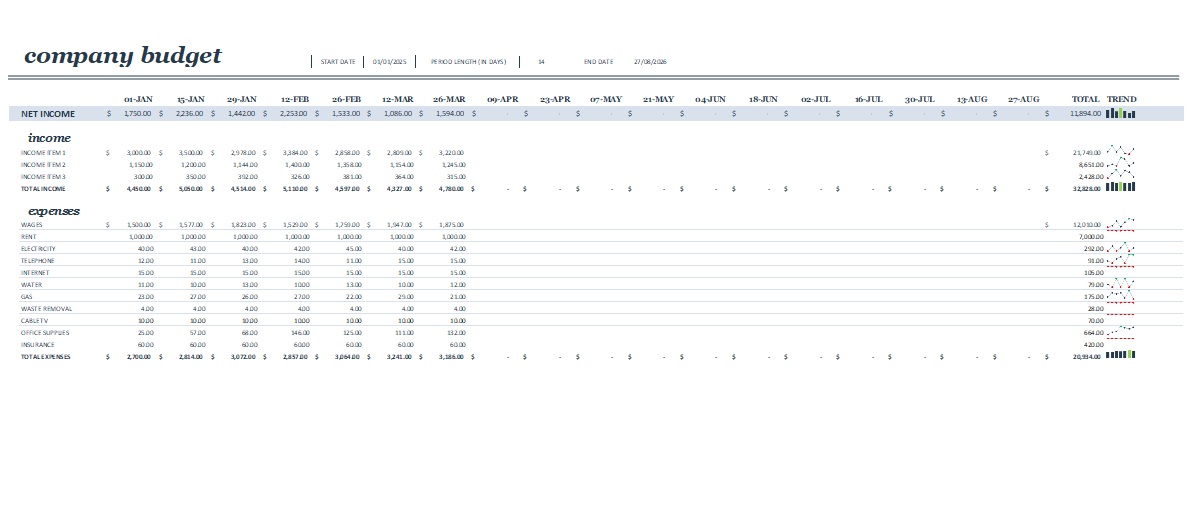
Not all templates are created equal. A basic list of expenses is not a budget; it is a ledger. To truly drive growth, your business budget template must encompass several key dimensions to provide a 360-degree view of your financial health. Here are the essential components every high-performing template must include:
- Revenue Projections: This section should be broken down by stream (e.g., product sales, service retainers, affiliate income). It should include both “conservative” and “aggressive” estimates to help you plan for various scenarios.
- Fixed Expenses (Overhead): These are the non-negotiables that stay consistent regardless of your sales volume.
- Rent/Mortgage
- Software subscriptions (SaaS)
- Insurance premiums
- Salaries and payroll taxes
- Variable Expenses: Costs that fluctuate based on production or sales volume.
- Raw materials/Inventory
- Shipping and logistics
- Freelance contractors
- Commission payments
- Capital Expenditures (CapEx): A dedicated area for one-time, high-cost investments such as new machinery, computers, or office renovations.
- The Emergency Fund/Contingency Line: A critical field where you allocate a percentage (typically 5-10%) of your budget for unforeseen expenses to avoid dipping into operational capital.
- Variance Column: A side-by-side comparison area showing Budgeted Amount vs. Actual Amount and the resulting Difference.
Step-by-Step Guide: How to Customize and Use Your Business Budget Template
Possessing a template is only half the battle; the value is created through the process of implementation. Follow this chronological workflow to transform your business budget template from a file into a financial engine.
Step 1: Gather Historical Data
Before entering numbers, review your profit and loss (P&L) statements from the previous 12 months. Look for patterns in seasonality—do your expenses spike in Q4? Does your revenue dip in July? This data prevents you from setting unrealistic goals based on guesswork.
Step 2: Set Your Financial Goals
Define what you want to achieve this year. Are you aiming for a 20% increase in net profit? Do you need to save $10,000 for a new piece of equipment? Your goals dictate where you allocate funds within the template.
Step 3: Populate Fixed and Variable Costs
Start with your “knowns”—your fixed costs. Once the overhead is established, estimate your variable costs based on your projected sales volume. If you plan to sell 1,000 units, your material costs must reflect that scale.
Step 4: The Monthly Review Cycle
A budget is a living document. At the end of every month, input your actual spending into the template. This is the most critical step. If you overspent in “Advertising,” analyze why. Was it a planned experiment or a waste of resources? Adjust the following month’s projections based on these insights.
Step 5: Quarterly Re-Forecasting
Every three months, perform a deep dive. Shift funds from under-utilized categories to high-growth areas. This agility allows you to capitalize on opportunities faster than competitors who only budget once a year.
Download Free Business Budget Worksheet in MS Excel

Best Practices & Common Mistakes to Avoid
To get the most out of your business budget template, avoid the “set it and forget it” mentality. Efficiency comes from integration and accuracy.
Pro-Tips for Efficiency:
Automate the Data Entry: If possible, link your template to your accounting software (like QuickBooks or Xero) via API or CSV exports to reduce manual entry errors.
Use “Conservative” Revenue Estimates: Always under-estimate your income and slightly over-estimate your expenses. This creates a financial cushion that reduces stress.
Pitfalls to Avoid:
Overcomplicating the Fields: Do not create 50 different categories for $10 expenses. Group similar costs together to keep the document readable.
Ignoring the “Small” Leaks: Many businesses overlook “ghost subscriptions”—small monthly fees for software no longer used. Regularly audit your fixed expenses to prune these leaks.
Frequently Asked Questions About Business Budgeting
How often should I update my business budget template?
You should record actual expenses weekly to maintain accuracy, but perform a formal budget review monthly. A monthly review allows you to spot trends and adjust your spending before a small variance becomes a major financial crisis.
What is the difference between a business budget and a cash flow forecast?
A business budget template is a plan of what you intend to earn and spend over a specific period. A cash flow forecast is a prediction of when that money will actually enter and leave your bank account. Budgeting is about planning; forecasting is about timing and liquidity.
How do I handle unexpected expenses that aren’t in my template?
This is why the “Contingency Line” is essential. When an unplanned expense arises, draw from your contingency fund first. If the expense is larger than the fund, you must either reduce a variable expense in another category or pivot your revenue goals to cover the gap.
Can I use a simple spreadsheet as a business budget template?
Yes, a spreadsheet (Excel or Google Sheets) is often the best starting point because of its flexibility. As long as it includes revenue projections, fixed/variable costs, and a variance analysis section, a spreadsheet is a powerful tool for any small to mid-sized business.
Conclusion: Take Control of Your Financial Future
Financial chaos is not a requirement of entrepreneurship. By implementing a structured business budget template, you shift from reactive management to proactive leadership. You gain the clarity needed to make bold moves, hire the right talent, and scale your operations with confidence. Don’t leave your growth to chance—start populating your template today and turn your financial vision into a measurable reality.