For many business owners and marketing managers, managing a promotional budget feels like trying to catch water with a sieve. You know money is going out—into Facebook ads, email software, freelance designers, and event sponsorships—but calculating exactly how much is returning to the bottom line often feels like guesswork. This is where a professional marketing budget template transforms from a simple spreadsheet into a strategic growth engine.
A marketing budget template is more than just a list of expenses; it is a financial roadmap. It allows you to forecast spending, allocate resources to the highest-performing channels, and maintain strict fiscal discipline. Whether you are a bootstrapped startup or an established enterprise, having a centralized document to track every dollar ensures that your marketing efforts are intentional, measurable, and, most importantly, profitable.
The Deep Dive: Why a Structured Marketing Budget is Non-Negotiable
Operating without a formal budget is the fastest way to encounter “budget creep,” where small, unmonitored expenses accumulate and deplete your reserves before your primary campaigns can even gain traction. The hidden value of a marketing budget template lies in its ability to provide absolute visibility.
When you implement a structured budget, you move from a reactive state (spending because you see an opportunity) to a proactive state (spending because you have a plan). This shift provides three critical business advantages:
- Accountability and Ownership: When budgets are allocated per channel (e.g., $2,000 for SEO, $1,000 for LinkedIn Ads), it becomes easy to identify which initiatives are over-performing and which are draining resources without delivering results.
- Precision in Scaling: You cannot scale what you cannot measure. A budget template allows you to calculate your Customer Acquisition Cost (CAC) accurately. Once you know that $100 in spend equals 5 new customers, you can confidently increase your budget to grow your revenue.
- Risk Mitigation: By forecasting your annual and quarterly spend, you avoid the “seasonal slump” where a business runs out of marketing funds during their most critical sales period.
The risk of ignoring this process is not just financial loss; it is the loss of strategic momentum. Without a budget, you are gambling with your growth, hoping that the mix of channels you’ve chosen will work, rather than knowing exactly why they are working.
Anatomy of a Perfect Marketing Budget Template
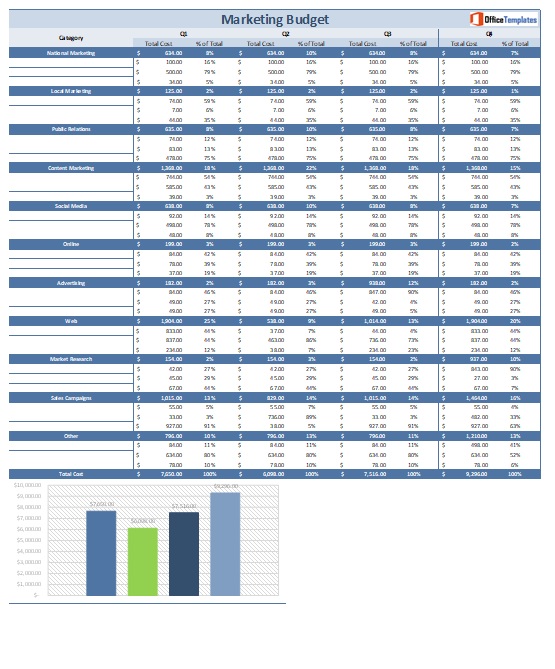
Not all spreadsheets are created equal. A high-performing marketing budget template must be granular enough to capture detail but simple enough to update weekly. To build or evaluate a template, ensure it contains the following core components:
1. The Summary Dashboard
This is the “at-a-glance” section. It should include your Total Annual Budget, Year-to-Date (YTD) Spend, and Remaining Balance. Visual aids like progress bars or simple pie charts showing spend distribution by channel are highly recommended here.
2. Expense Categorization (The Columns)
Your template should break down costs into clear categories to avoid confusion. Essential columns include:
- Line Item/Channel: (e.g., Google Ads, Content Marketing, Email Software, Trade Shows).
- Planned Spend: The amount you intend to spend for the period.
- Actual Spend: The amount that actually left the bank account.
- Variance: The difference between planned and actual spend (this highlights over-spending or under-utilization).
- Expected ROI/KPI: The specific goal tied to that spend (e.g., “100 Leads” or “20% Increase in Traffic”).
3. Cost Type Differentiation
A professional template distinguishes between Fixed Costs (software subscriptions, agency retainers) and Variable Costs (ad spend, pay-per-click, freelance project fees). This allows you to see your “burn rate” regardless of how aggressive your campaigns are.
4. Time-Phased Tracking
Budgets should be broken down by month or quarter. This allows you to account for seasonality—such as increasing spend in Q4 for the holiday rush or scaling back during a traditional industry lull.
Download Free Marketing Budget Template

Step-by-Step Guide: How to Customize and Use Your Template
Simply downloading a marketing budget template isn’t enough; you need a workflow to make the data actionable. Follow this chronological process to ensure your budget drives actual growth.
- Audit Your Historical Data: Before filling out the template, look at the last 6–12 months of spending. Identify what worked and what didn’t. This provides the baseline for your “Planned Spend” column.
- Define Your Top-Line Goal: Decide if this year is about aggressive growth (higher spend, lower immediate ROI) or efficiency (optimized spend, higher ROI). This determines whether you allocate more to experimental channels or proven winners.
- Allocate by Percentage: A common framework is the 70-20-10 rule: Allocate 70% of your budget to proven channels, 20% to emerging opportunities, and 10% to wild-card experiments.
- The Weekly Pulse Check: Assign a team member (or yourself) to update the “Actual Spend” column every Friday. This prevents the end-of-month shock where you realize you’ve spent 150% of your budget by the 15th day.
- The Monthly Pivot: At the end of each month, analyze the Variance and ROI. If your LinkedIn ads are underperforming but your SEO is exploding, shift the remaining budget from the former to the latter for the next month.
Best Practices & Common Mistakes to Avoid
To get the most out of your marketing budget template, keep these professional tips in mind:
Pro Tips for Efficiency:
Integrate your template with your accounting software (like QuickBooks or Xero) via CSV exports to minimize manual data entry. Additionally, use Conditional Formatting in your spreadsheet; set cells to turn red if the “Actual Spend” exceeds the “Planned Spend” by more than 10%.
Pitfalls to Avoid:
Avoid the “Set it and Forget it” mentality. A budget is a living document, not a static law. Another common mistake is overcomplicating the fields. If you have 50 different categories for spend, you will likely stop updating the document because it’s too tedious. Keep your categories broad but distinct.
Marketing Budget FAQs
How do I calculate my marketing budget for the first time?
If you have no historical data, start with a “Goal-Backwards” approach. Determine how many new customers you need to reach your revenue goals, estimate your average Customer Acquisition Cost (CAC) for your industry, and multiply the two. Alternatively, many small businesses start by allocating a fixed percentage of their projected gross revenue.
What is the ideal percentage of revenue to spend on marketing?
While it varies by industry, a general rule of thumb is that new businesses (growth phase) spend 12-20% of gross revenue on marketing, while established businesses (maintenance phase) spend 6-12%. Refer to your marketing budget template to see where you currently fall on this spectrum.
How often should I review and adjust my marketing budget?
You should track expenditures weekly, review performance monthly, and re-forecast your strategy quarterly. Marketing landscapes change rapidly (e.g., a sudden spike in ad costs), so a quarterly pivot ensures you aren’t wasting money on outdated strategies.
What is the difference between a marketing budget and a marketing plan?
A marketing plan is the strategy (the “what” and “how”), while the budget is the resource allocation (the “how much”). The plan outlines the target audience and the messaging; the marketing budget template ensures there is enough financial fuel to execute that plan without bankrupting the company.
Conclusion & Next Steps
A marketing budget template is the difference between guessing and growing. By implementing a structured system of tracking, analyzing, and adjusting your spend, you turn your marketing from an expense into an investment. Stop the financial leakage today: download or build your template, audit your last 30 days of spend, and take full control of your growth trajectory.