Imagine the chaos of a Tuesday morning: you’re rushing to start your workday, but your energetic pup is chewing the rug while you struggle to remember if you’ve already handled their morning exercise. When your daily routine feels like a balancing act, it is easy for essential habits to slip through the cracks, leaving both you and your pet feeling stressed. This is where a structured dog training schedule template becomes a game-changer, transforming unpredictable days into a streamlined system. By organizing your puppy training plan, you can easily balance positive reinforcement techniques with consistent potty training and vital socialization. Whether you are managing a complex work routine or a rigorous study habit, using a daily dog schedule ensures a predictable cadence for obedience training and mental stimulation. This organized approach removes the guesswork from puppy care, allowing you to focus on building a lasting bond through a reliable, stress-free habit tracker.
Why We Need Dog Training Schedule Template
Bringing a dog into your life is a joyful experience, but the reality of training often clashes with the chaos of a busy modern lifestyle. Many owners start with the best intentions, yet they quickly find themselves struggling with poor time management. When training is left to “when I have a free moment,” it rarely happens. This lack of consistency leads to missed sessions and stalled progress, which can cause frustration for both the owner and the dog. Without a roadmap, the mental load of remembering which command to work on or when the next potty break occurs becomes a source of daily stress.
A structured dog training schedule template transforms this overwhelming experience into a manageable routine. By externalizing the plan, owners no longer have to rely on memory, reducing the anxiety of forgotten deadlines or skipped repetitions. This clarity brings a sense of calm to the household, as the dog learns to anticipate expectations, which significantly reduces behavioral outbursts. Ultimately, moving from a reactive approach to a proactive, scheduled plan improves productivity and strengthens the emotional bond between pet and owner, turning the challenge of training into a predictable and rewarding journey.
Key Elements of Dog Training Schedule Template
An effective dog training schedule begins with clearly defined time slots, which provide a predictable rhythm for both the owner and the dog, reducing anxiety and establishing a reliable routine. Within these slots, detailed task descriptions are essential because they specify exactly which behaviors are being targeted—such as “sit-stay” or “loose-leash walking”—ensuring that training remains intentional rather than random. To prevent the owner from becoming overwhelmed, a priority system helps categorize these tasks, distinguishing between critical safety commands and optional tricks, which ensures that the most important skills are mastered first. These priorities naturally feed into broader goals, which serve as the North Star for the schedule by defining what success looks like over a week or month, keeping the trainer motivated and focused on long-term progress.
However, a rigorous schedule can lead to mental fatigue, making strategically placed breaks vital for preventing burnout and maintaining the dog’s enthusiasm for learning. These periods of rest allow the dog to process new information, making the subsequent training sessions more productive. To ensure these efforts are actually working, a progress tracking section is integrated into the template, allowing the owner to record wins or identify recurring struggles; this data-driven approach prevents the plateauing of skills by highlighting when it is time to increase the level of difficulty. Finally, the entire framework must be underpinned by a layer of flexibility. Because dogs are unpredictable and life is often chaotic, a flexible design allows for adjustments based on the dog’s mood or unexpected schedule shifts without the owner feeling like the entire program has failed. By blending these elements—structure through timing and goals, and sustainability through breaks and adaptability—the template transforms from a rigid set of rules into a practical roadmap that fosters a stronger, more communicative bond between a dog and its owner.
Free Dog Training Schedule Template to Download
Stop stressing over the planning and start focusing on the bonding! Our ready-made templates offer a convenient, stress-free way to organize your pup’s day. Simply download and go, using these easy-to-follow designs to build consistent habits and a happier, well-behaved dog with total ease.
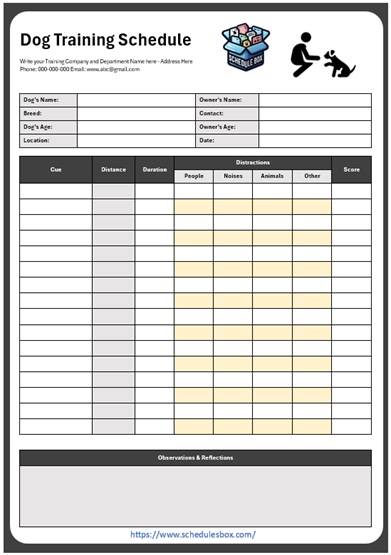

Understanding the various types of dog training schedule templates is essential because no two dogs are identical in their temperaments, ages, or behavioral needs. A one-size-fits-all approach to scheduling often leads to frustration for both the owner and the animal, as a high-energy Border Collie requires a vastly different daily structure than a senior Beagle or a brand-new rescue puppy. By selecting the right scheduling approach, owners can ensure that training is balanced with necessary rest, preventing burnout and ensuring that the dog remains motivated and engaged throughout the learning process.
Types of Dog Training Schedule Template
One of the most common starting points for many owners is the Puppy Integration Template. This specific approach is designed around the biological needs of a young dog, prioritizing frequent bathroom breaks, socialization windows, and short, high-frequency training bursts. Because puppies have limited attention spans and high energy levels, this template focuses on “micro-training” sessions that last only five to ten minutes, interspersed with naps and play. The goal is to weave basic obedience and house-training into the natural flow of the day, ensuring the puppy is not overwhelmed by too much stimulation at once.
As a dog transitions from puppyhood into adolescence or adulthood, the focus often shifts toward the Behavioral Modification Template. This type of schedule is far more targeted and is typically utilized for dogs struggling with specific issues such as separation anxiety, reactivity, or resource guarding. Unlike a general puppy schedule, this template allocates dedicated time for “desensitization” and “counter-conditioning” exercises. It emphasizes consistency and repetition, often scheduling several short exposures to a trigger throughout the day to gradually change the dog’s emotional response to a stimulus, while ensuring there are ample “decompression” periods to allow the dog’s cortisol levels to drop.
For those with high-drive working breeds, the Mental Stimulation and Energy Burn Template becomes the ideal choice. This approach recognizes that physical exercise alone is often insufficient for intelligent breeds who require a “job” to remain settled. This schedule integrates physical activity, such as long walks or fetch, with cognitively demanding tasks like scent work, puzzle feeding, and advanced trick training. The narrative of this schedule is built around the concept of “tiring the mind to tire the body,” ensuring that the dog is mentally exhausted before they are expected to practice calm, sedentary behaviors in the home.
Finally, for owners who are focusing on refining skills or preparing for competitions, the Advanced Skill Acquisition Template is used. This structured approach treats training more like an athletic regimen, incorporating warm-up periods, focused repetitions of complex commands, and “maintenance” sessions for previously learned behaviors. It is designed for the disciplined owner and dog, focusing on precision and duration rather than basic compliance. By alternating between high-intensity learning sessions and low-impact activity, this template helps prevent physical injury and mental fatigue, allowing the dog to reach a level of mastery and reliability in various environments.
Optimizing Your Dog Training Schedule Template
Understanding the common pitfalls of a dog training schedule is essential because a plan is only as effective as its alignment with a dog’s biological needs and a human’s actual capacity. Many owners approach training with a rigid, corporate mindset, treating a puppy or an adolescent dog like a project with a deadline rather than a living creature with fluctuating energy levels. When a schedule is unrealistic or poorly structured, it doesn’t just lead to missed sessions; it often leads to owner burnout and canine frustration. By recognizing these mistakes early, you can transition from a fragile plan that breaks under pressure to a flexible framework that fosters a genuine bond and sustainable behavioral progress.
Navigating the Pitfalls of Rigid Planning
One of the most pervasive errors in training templates is the tendency toward over-scheduling, where owners pack every hour with structured learning and “work.” This often stems from a place of enthusiasm and a desire for fast results, but it ignores the critical necessity of decompression. When a dog is pushed through back-to-back sessions without adequate downtime, they reach a state of mental fatigue where learning stops and stress takes over. This cognitive overload often manifests as “zoomies,” destructive chewing, or sudden disobedience, which the owner may mistakenly interpret as a lack of progress or a “stubborn” temperament, when in reality, the dog is simply exhausted.
This drive for constant productivity often leads directly into the mistake of ignoring the biological clock, particularly regarding the balance between activity and sleep. New owners frequently underestimate how much a puppy actually needs to sleep, filling the template with training blocks while ignoring the necessity of forced naps. When training is attempted during a window where the dog should be sleeping, the sessions become battles of will rather than lessons in behavior. This mismanagement of energy creates a cycle of overstimulation, where the dog becomes hyperactive and impossible to settle, ultimately making the training schedule a source of stress rather than a helpful guide.
As the owner attempts to correct this hyperactivity, they often fall into the trap of prioritizing quantity over quality. Many templates focus on the duration of the session—such as a mandatory thirty-minute block—rather than the intensity and success rate of the interaction. When a session is dragged out too long, the dog loses focus, and the owner begins to repeat commands without clear markers, leading to “nagging” and a decrease in the value of the reward. This shift from short, high-value bursts to long, tedious marathons erodes the dog’s engagement and can make the training process feel like a chore for both parties.
Finally, a critical oversight in many schedules is the lack of adaptability for environmental variance. A template that works perfectly in a quiet living room often fails when applied to a park or a busy street because it does not account for the “difficulty spike” of different locations. By treating all training blocks as equal, owners often set their dogs up for failure by asking for a complex behavior in a high-distraction environment without a gradual transition. This lack of scalability leads to frustration and a perceived loss of progress. To avoid this, the schedule must be viewed as a living document that evolves based on the dog’s current emotional state and the specific challenges of the surrounding environment.