We have all experienced that frantic moment when a calendar becomes a blur of overlapping commitments, leaving us scrambling to remember who is arriving when and where they need to be. Whether you are coordinating a high-stakes hiring spree or managing a complex series of academic evaluations, the chaos of manual tracking often leads to costly scheduling conflicts and missed opportunities. This is where a professional interview schedule template becomes an essential asset, transforming a stressful logistics nightmare into a streamlined process. By using a structured hiring timeline and a detailed candidate tracking sheet, you can easily organize your interview slots and manage recruiter workflows without the mental clutter. These tools are invaluable for any professional routine, allowing you to maintain an efficient interview process and a clear interview calendar. Whether for corporate recruitment, student training, or work evaluations, this organized approach ensures a positive candidate experience and a seamless transition from initial screening to the final offer.
Why We Need Interview Schedule Template
The process of hiring or conducting research often feels like a chaotic balancing act. Without a structured framework, it is easy to fall into the trap of poor time management, where overlapping appointments lead to rushed conversations and missed deadlines. When a recruiter or researcher relies on memory or fragmented notes, consistency vanishes, and the quality of the candidate experience suffers. This lack of routine creates a breeding ground for stress, leaving professionals feeling overwhelmed as they scramble to keep track of who to call, when to meet, and which goals to address.
Implementing an interview schedule template transforms this frantic energy into a streamlined system. By mapping out every transition and time block, a template eliminates the cognitive load of deciding what comes next, allowing the interviewer to be fully present. This structure ensures that every candidate is treated with the same rigor and fairness, removing the unpredictability that often leads to burnout. Ultimately, a dedicated template replaces confusion with clarity, turning a potentially stressful gauntlet into a productive, rhythmic process that protects the user’s mental bandwidth and ensures professional excellence.
Key Elements of Interview Schedule Template
An effective interview schedule template begins with precisely defined time slots, which establish a clear rhythm for the day and ensure that candidates and interviewers are aligned on expectations. These slots are most useful when paired with detailed task descriptions, as specifying whether a block is for a technical assessment, a behavioral round, or a cultural fit interview prevents confusion and allows the panel to prepare their specific lines of questioning. To ensure the most critical evaluations are handled with full focus, these tasks should be categorized by priority, highlighting the “must-have” competencies that need to be verified first. This prioritization naturally ties into the overarching goals of the interview process, as the schedule must explicitly state what a successful outcome looks like for each segment, keeping the evaluators focused on objective data rather than intuition.
Recognizing that cognitive fatigue can cloud judgment, a practical template integrates intentional breaks and transition buffers between candidates. These intervals are vital for allowing interviewers to synthesize their notes, reset their mental state, and avoid the bias that occurs when one candidate is unfairly compared to the immediate predecessor. To maintain operational control throughout the day, the template should incorporate a system for tracking progress, such as a status column to mark completed stages or pending feedback. This real-time tracking ensures that the hiring team knows exactly where they stand in the pipeline without needing constant manual updates. Finally, the entire structure must be underpinned by a layer of flexibility. By building in “flex time” or contingency windows, the schedule can accommodate unexpected delays or deep-dive conversations that run long without causing a domino effect of delays for subsequent candidates. When these elements flow together, the schedule transforms from a rigid calendar into a strategic tool that balances rigorous evaluation with a positive, professional candidate experience.
Free Interview Schedule Template to Download
Take the stress out of hiring with our ready-made interview schedule templates. Designed for convenience and ease of use, these professional layouts help you organize your day effortlessly. Simply download your favorite design and start coordinating your candidates with confidence and clarity.
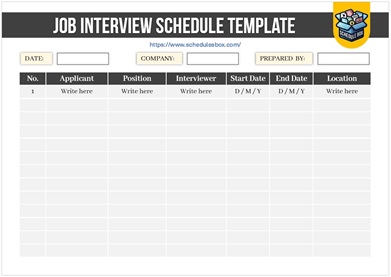

Understanding the various types of interview schedule templates is critical because the hiring process is rarely a one-size-fits-all endeavor. Depending on the seniority of the role, the volume of candidates, and the specific technical skills being evaluated, the structure of the interview day can drastically change. A rigid, linear approach might work for an entry-level position, but it could alienate a high-level executive who expects a more conversational, strategic dialogue. By matching the scheduling approach to the specific needs of the role, organizations can ensure a consistent candidate experience, minimize interviewer fatigue, and gather the most accurate data to make an informed hiring decision.
Types of Interview Schedule Template
One of the most common approaches is the Standard Linear Template, which is designed for roles requiring a steady progression of evaluation. In this model, the candidate moves through a series of predetermined stages, starting with a recruiter screen and moving toward a hiring manager interview and eventually a peer review. This template is ideal for high-volume hiring where consistency is paramount, as it ensures every candidate is asked the same set of questions in the same order, reducing bias and allowing the company to compare applicants on a level playing field.
As the complexity of a role increases, many organizations transition toward a Panel Interview Template. Unlike the linear approach, this template concentrates multiple stakeholders into a single time block. This method is particularly effective for collaborative roles where cross-functional alignment is necessary. By scheduling a panel, the company reduces the total number of interview rounds the candidate must endure, which accelerates the hiring timeline and allows the interviewers to discuss their impressions in real-time. The focus here is on observing how the candidate interacts with a group and how they handle diverse perspectives simultaneously.
For highly technical roles, such as software engineering or data analysis, the Technical Assessment Template becomes necessary. This schedule is distinct because it carves out a significant portion of time for a “live” demonstration of skills, such as a coding challenge or a whiteboard session. Rather than focusing solely on behavioral traits, this template balances a brief introductory conversation with a deep dive into problem-solving capabilities. It often includes a dedicated “buffer” period for the candidate to reset after the intensity of the technical test before moving into a final cultural fit discussion.
In contrast to these structured formats, the Executive Loop Template is designed for senior leadership. This approach is less about checking boxes and more about strategic alignment. The schedule is typically spread across a full day or two separate days, featuring long-form conversations with C-suite executives and stakeholders. These sessions are designed to be fluid, allowing for deep dives into the candidate’s vision and leadership philosophy. The pacing is slower, providing ample time for the candidate to ask their own probing questions about the company’s future, reflecting the high stakes and mutual evaluation inherent in executive hiring.
Finally, for those utilizing a more agile or modern approach, the Speed Interviewing Template offers a rapid-fire sequence of short encounters. This is often used during career fairs or internal “talent days” where the goal is to filter a large pool of candidates quickly. Each segment is timed strictly, focusing on high-level qualifications and immediate chemistry. While less thorough than a loop, it serves as an efficient funnel to determine who should be moved into a more comprehensive scheduling template.
Optimizing Your Interview Schedule Template
Understanding the common pitfalls of an interview schedule template is essential because the schedule serves as the blueprint for the entire candidate experience. When a template is flawed, it does not just create administrative friction; it can actively sabotage the quality of the hire. An unrealistic or poorly structured schedule often leads to interviewer burnout, rushed evaluations, and a disorganized impression that may drive top-tier talent toward competitors. By recognizing where these templates typically fail, hiring managers can shift from a rigid, theoretical timeline to a flexible, realistic framework that respects both the interviewer’s time and the candidate’s mental energy.
The Pitfalls of Rigid Timing and Over-Scheduling
A frequent mistake begins with the tendency to schedule interviews back-to-back without any transitional buffers. This happens because planners often view the interview as a discrete block of time—such as exactly sixty minutes—forgetting that human interaction rarely adheres to a stopwatch. When one conversation runs long or a technical glitch delays a virtual meeting, a domino effect occurs, leaving subsequent interviewers frustrated and candidates feeling rushed. This lack of “breathing room” prevents interviewers from synthesizing their notes immediately after the conversation, which is when insights are freshest. Consequently, the evaluation becomes a rushed afterthought rather than a thoughtful analysis.
This pressure to maximize every minute often leads into the mistake of over-scheduling the candidate’s day. In an attempt to be thorough, companies may cram five or six interviews into a single afternoon. While this seems efficient from a corporate perspective, it ignores the reality of cognitive fatigue. By the fourth hour, both the candidate and the interviewers are exhausted, leading to repetitive questioning and a decline in the quality of the dialogue. This fatigue obscures the candidate’s true potential and often results in a generic, tired version of the interview process that fails to uncover the nuanced skills required for the role.
Beyond the timing of the day, many templates fail by neglecting the strategic sequence of the interviews. It is common to see schedules where the most taxing technical assessments are placed at the end of a long day, or where the “cultural fit” conversation happens before the candidate has even demonstrated their core competencies. When the sequence is illogical, the narrative of the interview process feels fragmented. This lack of flow can confuse the candidate and leave the hiring team with a disjointed set of data points rather than a comprehensive picture of the individual’s capabilities.
Furthermore, many organizations make the mistake of treating the schedule as a static document rather than a communication tool. Often, the template focuses heavily on the “when” and “where” but fails to provide the “who” and “why.” When interviewers are simply told they have a slot from two to three o’clock without a clear objective or a specific set of focus areas for that session, they often overlap in their questioning. This results in a redundant experience for the candidate, who finds themselves answering the same questions repeatedly. This redundancy not only wastes precious time but also signals a lack of internal alignment and professional coordination.
Finally, a subtle but damaging error is the failure to account for the “wrap-up” period at the end of the total schedule. Templates often end the moment the final interview concludes, leaving no time for the hiring team to huddle or for the candidate to have a clean exit. When the schedule is this tightly wound, the transition from the final interview to the conclusion feels abrupt and cold. By incorporating a dedicated cooldown period, teams can ensure they end the process on a high note, leaving the candidate with a lasting impression of a thoughtful, well-organized, and human-centric organization.