In any service-based business, the gap between a verbal quote and a final invoice is where most client disputes happen. Whether you are a freelance consultant, a medical practitioner, a lawyer, or a boutique agency, transparency is the bedrock of client trust. This is where a fee schedule template becomes an indispensable asset for your administrative toolkit.
A fee schedule is more than just a price list; it is a formal document that outlines the costs associated with specific services, the frequency of billing, and the terms under which those fees are applied. By standardizing your pricing structure, you eliminate ambiguity, reduce “scope creep,” and project a level of professionalism that allows you to command higher rates. In this comprehensive guide, we will explore how to utilize a fee schedule template to optimize your revenue cycle and improve client relations.
What Is a Fee Schedule Template?
A fee schedule template is a pre-formatted document designed to help service providers list their charges in a clear, organized, and standardized manner. Unlike a casual quote or a one-off estimate, a fee schedule serves as a master reference for the pricing of all available services offered by a business or professional.
Depending on the industry, these templates vary. In healthcare, a fee schedule might list CPT codes and the corresponding reimbursement rates. For a graphic designer, it might detail hourly rates, flat fees for logos, and rush-order premiums. Regardless of the niche, the core objective remains the same: to provide a definitive, written record of what a client will be charged for specific deliverables or time increments.
Purpose and Importance
Why invest time in a formal fee schedule when a simple email mentioning a price might suffice? The importance lies in risk mitigation and operational efficiency.
- Eliminating Ambiguity: When pricing is documented, there is no “he said, she said” regarding the cost of a service. It sets clear expectations from the first point of contact.
- Standardizing Revenue: A template ensures that you charge all clients consistently for the same service, preventing accidental undercharging or inconsistent pricing that could lead to fairness disputes.
- Facilitating Onboarding: New clients can review your fee schedule during the onboarding process, allowing them to budget accordingly and select the service tier that fits their needs.
- Legal Protection: In many professional industries, having a signed fee agreement based on a standardized schedule is a requirement for compliance and a primary defense against payment disputes.
Key Elements Included in a Fee Schedule
To be effective, a fee schedule template must be comprehensive. A bare-bones list of prices is rarely enough. A professional document should include the following sections:
1. Header and Business Information
This includes your business name, logo, contact information, and the effective date of the schedule. Since prices change annually, the “Effective Date” is critical for version control.
2. Categorized Service Lists
Rather than a random list, services should be grouped by category (e.g., “Consultation Services,” “Implementation Phase,” “Monthly Maintenance”). This makes the document skimmable and user-friendly.
3. Pricing Units
Clearly define how you charge. Common units include:
- Hourly Rates: The cost per 60 minutes of work.
- Flat Fees: A set price for a specific deliverable regardless of time spent.
- Retainers: A recurring monthly fee for a guaranteed amount of availability.
- Per-Unit Pricing: Charging based on the number of items produced (e.g., per page or per lead).
4. Variable Costs and Surcharges
Include sections for “Rush Fees,” “Travel Expenses,” or “Administrative Costs.” Documenting these prevents the friction that occurs when a client sees an unexpected line item on a final invoice.
5. Payment Terms and Conditions
Briefly outline when payment is due (e.g., Net 30), accepted payment methods, and policies regarding deposits or non-refundable retainers.
Download Fee Schedule Sheet for Free
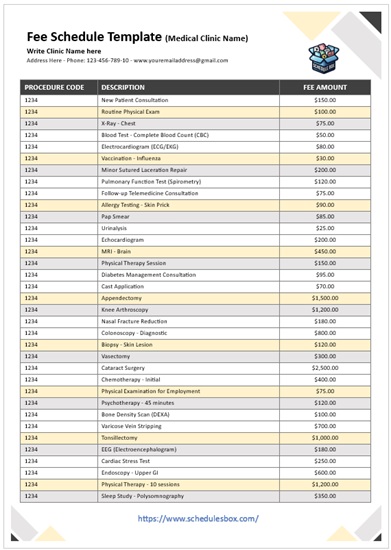

Benefits of Using a Template
Creating a document from scratch every time you update your pricing is inefficient. Utilizing a structured fee schedule template offers several strategic advantages:
Time Savings and Productivity
Instead of spending hours formatting tables and columns, a template allows you to simply plug in your updated rates. This frees up administrative time to focus on high-value billable work.
Professional Appearance
A clean, well-formatted document signals to the client that you are an established professional. A haphazardly typed list of prices can make a business look amateur, which may lead clients to negotiate your rates downward.
Consistency Across the Organization
For firms with multiple employees or contractors, a template ensures everyone is quoting the same prices. This prevents the confusion that arises when two different account managers give a client two different price points for the same service.
Improved Record Keeping
By saving different versions of your fee schedule template over the years, you can track your pricing evolution and analyze how price increases have impacted your client acquisition and retention rates.
Who Can Use This Template?
The versatility of a fee schedule template makes it applicable across a vast array of sectors. Here are the most common use cases:
Freelancers and Independent Contractors
Virtual assistants, copywriters, and developers use fee schedules to define their “menu of services,” allowing clients to mix and match offerings based on their budget.
Medical and Wellness Practitioners
Therapists, chiropractors, and private clinics use these templates to list procedure costs, insurance co-pays, and non-covered service fees to ensure patient transparency.
Legal Professionals
Attorneys use detailed fee schedules to break down hourly rates for associates versus partners, as well as flat fees for standard filings or consultations.
Educational Institutions and Tutors
Private tutors or specialty coaching centers use them to outline tuition rates, registration fees, and material costs for students and parents.
B2B Agencies
Marketing and SEO agencies utilize fee schedules to distinguish between one-time setup fees and ongoing monthly management retainers.
How to Customize the Template
To get the most out of your fee schedule template, you shouldn’t just fill in the blanks—you should tailor it to your business model. Follow these steps for a professional customization:
- Define Your Pricing Logic: Before editing the template, decide if you are positioning yourself as a “premium” provider (higher flat fees) or a “competitive” provider (lower hourly rates).
- Simplify the Language: Avoid industry jargon. If you are a technical consultant, instead of listing “API Integration Phase 1,” use “Connecting Your Software to Third-Party Tools.” This ensures the client understands exactly what they are paying for.
- Implement Visual Hierarchy: Use bold headings for categories and shaded rows for different pricing tiers. This prevents the document from looking like a wall of text.
- Add a Disclaimer: Include a small note stating that “Prices are subject to change with [X] days’ notice.” This gives you the flexibility to adjust rates without feeling locked into a price for eternity.
- Export to Non-Editable Formats: Once customized, always send the document to clients as a PDF. This prevents accidental edits and maintains the professional formatting.
Common Mistakes to Avoid
Even with a great template, certain errors can undermine your professionalism. Be mindful of the following:
- Over-complicating the Tiers: Offering too many pricing options can lead to “analysis paralysis” for the client. Stick to three main tiers or a clear a la carte menu.
- Forgetting the “Effective Date”: Sending a client a price list from 2022 in 2024 is a recipe for a billing nightmare. Always date your documents.
- Vague Service Descriptions: Avoid terms like “Miscellaneous Work.” Be specific. “Administrative Support” is better; “Email Management and Calendar Scheduling” is best.
- Hidden Fees: Do not leave “hidden” costs out of the schedule only to add them to the invoice. If there is a software subscription fee required for the project, list it in the fee schedule.
Related Templates and Documents
A fee schedule is part of a larger ecosystem of business documentation. To fully professionalize your billing process, consider implementing these related templates:
- Service Agreement/Contract: While the fee schedule lists the price, the contract makes the payment legally binding.
- Professional Invoice Template: A document that references the fee schedule to request payment for work completed.
- Project Proposal Template: A document used to pitch a specific solution, often utilizing a “custom” selection of items from the master fee schedule.
- Client Onboarding Checklist: A guide to ensure the client has signed the fee schedule and understands the billing cycle.
- Time Tracking Sheet: For those using hourly rates, a detailed log of hours is essential to justify the invoice based on the fee schedule.
Frequently Asked Questions (FAQ)
What is the difference between a fee schedule and a quote?
A fee schedule is a master list of standardized prices for all your services. A quote (or estimate) is a personalized document sent to a specific client, selecting only the services and quantities relevant to their unique project, derived from the master fee schedule.
Should I provide my fee schedule publicly on my website?
This depends on your business model. Public pricing (Transparent Pricing) can filter out low-budget leads and attract serious clients. However, if your services are highly bespoke, it is better to provide the fee schedule privately during the discovery phase.
How often should I update my fee schedule template?
Most professionals review their rates annually to account for inflation, increased expertise, and market demand. Some high-growth agencies may update their schedules quarterly.
Can a fee schedule be used for non-profit organizations?
Yes. Non-profits often use fee schedules for membership dues, workshop registrations, or sliding-scale service fees for community programs.
Is a fee schedule legally binding?
On its own, a fee schedule is an informational document. However, if it is attached as an exhibit to a signed contract or service agreement, it becomes a legally binding part of the agreement.
What is a “Sliding Scale” fee schedule?
A sliding scale is a variation of the fee schedule where the price is adjusted based on the client’s income level. This is common in therapy and social services to ensure accessibility while maintaining revenue.
Conclusion
Precision in pricing is the hallmark of a mature business. By implementing a fee schedule template, you move away from guesswork and toward a scalable, professional operation. Not only does it save you countless hours of administrative repetition, but it also fosters a relationship of honesty and transparency with your clients.
Remember, the goal is not just to list prices, but to communicate the value of your expertise. When your pricing is structured, clear, and professional, clients stop questioning the cost and start focusing on the results. Whether you are refining your current rates or launching a new service line, start with a robust template to ensure your business is positioned for sustainable growth and effortless billing.
“`