Owning a home is often the most significant financial investment of a person’s life, yet many homeowners treat maintenance as a reactive game of “whack-a-mole.” You fix the leak after the ceiling stains; you replace the HVAC filter after the airflow drops; you scrape the paint after it begins to peel. This reactive approach doesn’t just cause stress—it leads to catastrophic expenses that could have been avoided with a few hours of preventative care.
This is where a house maintenance list template becomes an indispensable asset. Far more than a simple “to-do” list, a structured maintenance template serves as a strategic roadmap for your home’s health. By transitioning from a memory-based system to a documented schedule, you ensure that no critical system—from the roof flashing to the sump pump—is overlooked, effectively shifting your home management from chaotic crisis mode to streamlined precision.
The Hidden Value: Why a House Maintenance List Template is Non-Negotiable
Most homeowners underestimate the “invisible” decay of a property. While a cracked window is obvious, the slow degradation of sealant around a window frame or the gradual buildup of sediment in a water heater is not. Without a house maintenance list template, these small failures compound, leading to systemic collapses that can cost tens of thousands of dollars.
Beyond preventing disaster, a rigorous maintenance log provides three critical strategic advantages:
- Preservation of Equity: Homes that have been meticulously maintained sell for significantly higher prices. A documented history of care proves to potential buyers that the home is structurally sound and mechanically efficient.
- Extended Appliance Lifespan: Regular servicing of HVAC units, refrigerators, and dishwashers can extend their operational life by 25% to 50%, delaying expensive replacements.
- Energy Efficiency: Simple tasks like weatherstripping and HVAC filter changes directly impact your monthly utility bills. A template ensures these high-ROI tasks happen on schedule.
The risk of ignoring this system is not just a leaky faucet; it is the “compounding effect of neglect.” When you miss one year of gutter cleaning, you risk ice dams; ice dams lead to roof leaks; roof leaks lead to mold in the attic; mold leads to structural rot. A template breaks this cycle by enforcing a cadence of prevention.
Anatomy of a Perfect House Maintenance List Template
Not all checklists are created equal. A generic list of chores is insufficient; a professional-grade house maintenance list template must be categorized by frequency and system to be truly effective. To build or evaluate a high-quality template, ensure it contains the following core components:
1. Temporal Categorization (The Frequency Pillars)
Tasks should be divided by when they must occur to prevent the user from feeling overwhelmed:
- Monthly: High-wear items (HVAC filters, smoke detector tests, garbage disposal cleaning).
- Quarterly: Seasonal transitions (Checking window seals, testing GFCIs, cleaning range hood filters).
- Bi-Annually: Spring and Fall deep dives (Gutter cleaning, HVAC professional tuning, sump pump testing).
- Annually: Major system audits (Water heater flushing, chimney sweeping, exterior paint inspection).
2. Essential Data Fields
Each line item in your template should include more than just a checkbox. For a complete audit trail, include:
- Task Description: A clear action (e.g., “Flush Water Heater” rather than just “Water Heater”).
- Target Date: When the task should be completed.
- Completion Date: When the task was actually completed.
- Service Provider: Whether it was a DIY job or handled by a licensed professional (include company name and contact).
- Cost: The expenditure associated with the task for future budgeting.
- Notes/Observations: A space to record “noticed slight wear on the belt” to flag future repairs.
3. System-Based Grouping
Organize the template by the home’s “organs” to make the workflow logical: Plumbing, Electrical, HVAC, Exterior/Roofing, and Interior/Cosmetic.
Download Free House Maintenance List Template
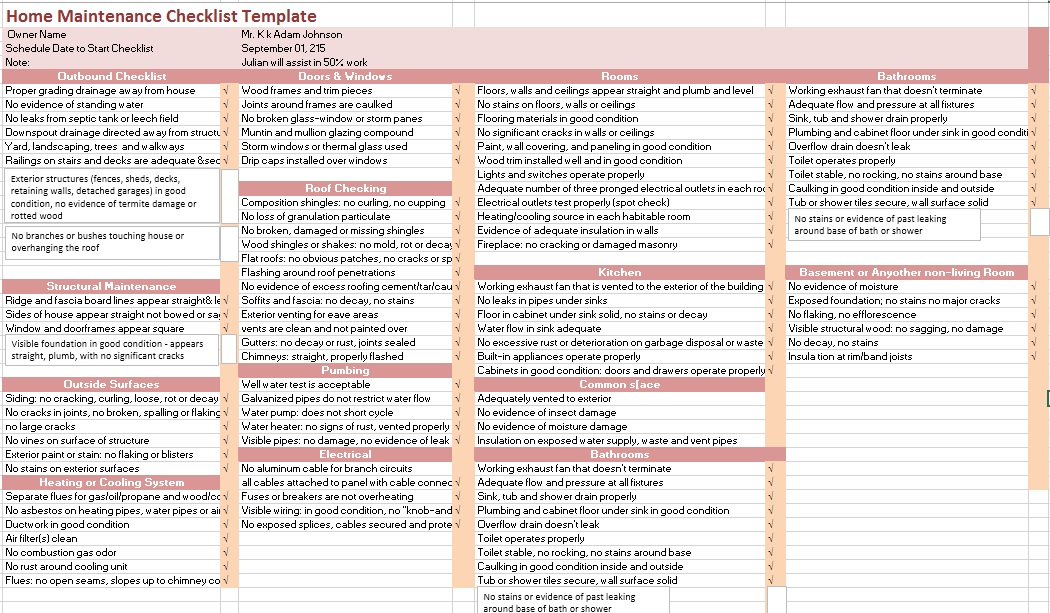

Step-by-Step Guide: How to Customize and Implement Your Template
A template is only useful if it is actually used. To move your house maintenance list template from a digital file to a living document, follow this operational workflow:
Step 1: The Home Audit
Before filling out your template, walk through your home with a notepad. Note the age of your roof, the brand of your HVAC, and the date of your last plumbing inspection. Customize the template by removing items that don’t apply (e.g., remove “Septic Tank Pumping” if you are on a city sewer) and adding specific items that do (e.g., “Pool Pump Winterization”).
Step 2: Establish a “Maintenance Day”
Do not try to tackle the list sporadically. Schedule a recurring “Home Health Day” once a month (e.g., the first Saturday). Use this day to execute all monthly tasks and one “deep dive” quarterly or annual task. This creates a psychological habit of ownership.
Step 3: Digital Integration and Alerts
While printable lists are great for the garage wall, digital versions are superior for tracking. Upload your template to a tool like Google Sheets, Notion, or a dedicated home management app. Set calendar alerts two weeks before a major annual task (like gutter cleaning) so you have time to book a professional if needed.
Step 4: The Hand-Off Protocol
If you share a home, assign specific sections of the template to different partners. One person may handle the interior filters and smoke detectors, while the other manages the exterior landscaping and gutter checks. Accountability is the key to consistency.
Best Practices & Common Mistakes to Avoid
To maximize the efficiency of your house maintenance list template, keep these professional tips in mind:
Pro-Tips for Efficiency:
- Bundle Your Tasks: If you are climbing a ladder to clean gutters, use that time to inspect the roof shingles and fascia boards. Never perform a high-effort task in isolation.
- Keep a “Parts Inventory”: Note the exact model numbers of your filters and bulbs within the template so you can order them in bulk without measuring every time.
Common Pitfalls to Avoid:
- Overcomplicating the List: Don’t track every lightbulb change. Focus on preventative maintenance that protects the structure and expensive systems.
- The “Set It and Forget It” Mentality: A template is a living document. As you add a new deck or install solar panels, update the template immediately to include their specific care requirements.
- Ignoring the “Notes” Section: The most valuable part of the template is the history. Recording a “small leak” today helps a plumber diagnose a “major burst” three years from now.
Frequently Asked Questions About House Maintenance Templates
How often should I update my house maintenance list template?
While the core structure of your house maintenance list template remains the same, you should review and update the “Notes” and “Completion Dates” in real-time. A comprehensive review of the entire schedule should happen annually—typically at the start of spring—to adjust for the upcoming year’s weather patterns and the aging of your home’s systems.
Can I use a digital app instead of a printable template?
Yes, and it is often encouraged. Digital templates allow for cloud backup, photo attachments (to document the “before and after” of a repair), and automated reminders. However, many homeowners find a printed copy on the fridge or in a utility closet more effective for daily accountability. A hybrid approach—digital for record-keeping and print for execution—is usually the most successful.
What is the most critical item to include in a maintenance template?
While all are important, water management is the most critical. Items such as gutter cleaning, sump pump testing, and caulking window seals prevent water intrusion, which is the primary cause of structural failure and mold. If you only focus on a few areas of your house maintenance list template, prioritize everything that keeps water out of your walls and foundation.
Do I need a professional to do everything on the list?
Absolutely not. The goal of a template is to identify what can be handled by the homeowner (DIY) and what requires a licensed professional. For example, changing an HVAC filter is a DIY task; tuning the refrigerant levels in that same HVAC system is a professional task. Your template should clearly distinguish between “DIY” and “Pro” to help you budget your time and money.
Conclusion: Take Control of Your Home’s Future
A home is an asset, but without a system, it can quickly become a liability. By implementing a house maintenance list template, you stop guessing and start managing. You protect your equity, reduce your stress, and ensure your sanctuary remains safe for years to come. Don’t wait for the next leak—download or create your template today and take the first step toward proactive homeownership.