There is nothing more damaging to a brand’s reputation than a customer opening a package only to find a critical item missing or the wrong product entirely. Whether you are a burgeoning e-commerce entrepreneur or a seasoned logistics manager, the “missing item” phone call is a nightmare scenario. This is where a professional packing list template transforms from a simple piece of paper into a critical quality-control mechanism. A packing list is more than just a list of contents; it is the final handshake between your warehouse and your customer, ensuring transparency, accountability, and operational excellence.
The Deep Dive: Why a Standardized Packing List Template is Non-Negotiable
At first glance, a packing list may seem redundant—after all, the customer already has an order confirmation and an invoice. However, the packing list serves a distinct functional purpose in the supply chain. While an invoice focuses on the financial transaction (what was paid), the packing list focuses on the physical reality (what is actually in the box).
Using a structured packing list template provides three primary pillars of value:
- Error Reduction and Quality Assurance: A template forces a “double-check” workflow. When a warehouse picker must check off an item on a physical or digital list, the cognitive act of verification significantly reduces the likelihood of shipping errors.
- Streamlined Receiving for the Client: For B2B transactions, the receiving department doesn’t care about the price; they care about the SKU and quantity. A clear packing list allows them to reconcile the shipment against their purchase order (PO) in seconds, speeding up the unloading process and payment cycles.
- Legal and Customs Compliance: For international shipping, a packing list is often a legal requirement. Customs officials use it to verify the contents of a shipment to ensure everything is declared correctly and that the duties applied match the physical goods. Without a detailed list, shipments can be delayed or seized.
The risk of ignoring this document is high. Without a standardized system, you face “invisible” costs: the price of shipping replacement items, the labor cost of customer service disputes, and the long-term erosion of customer trust.
Anatomy of a Perfect Packing List Template: Essential Components
Not all templates are created equal. A generic list of items is insufficient for professional logistics. To be truly effective, your packing list template must contain specific data fields that facilitate quick scanning and verification. Here are the essential components every high-performing template must include:
1. Header & Administrative Data
- Company Branding: Your logo and contact information to ensure the recipient knows exactly who sent the shipment.
- Document Title: Clearly labeled as “Packing List” to distinguish it from an invoice or a quote.
- Date of Shipment: Crucial for tracking lead times and identifying delays.
- Order/PO Number: The unique identifier that links the shipment back to the original customer request.
2. Shipping & Destination Details
- Ship-From Address: The specific warehouse or facility location where the goods originated.
- Ship-To Address: The complete delivery address, including a specific contact person or department name to prevent internal misrouting.
- Shipping Method: (e.g., FedEx, DHL, Freight) to help the receiver know which carrier to expect.
3. The Itemized Content Table
This is the core of the document. It should be structured in a clean, tabular format with the following columns:
- SKU/Item Number: The unique alphanumeric code for the product. This is the most accurate way to identify items.
- Product Description: A brief, clear name of the item (e.g., “Wireless Ergonomic Mouse – Matte Black”).
- Quantity Ordered: How many the customer requested.
- Quantity Shipped: How many are actually in this specific box. This is vital for partial shipments.
- Unit of Measure: (e.g., Each, Set, Box, kg) to avoid confusion over quantity.
4. Logistics & Verification Footer
- Total Package Count: (e.g., “Box 1 of 3”) so the receiver knows if a package is missing from the shipment.
- Weight and Dimensions: Useful for carrier verification and freight audits.
- Verification Signature: A space for the packer to sign or initial, creating a trail of accountability.
Step-by-Step Guide: How to Customize and Implement Your Template
Simply having a packing list template is not enough; you must integrate it into your daily operational workflow. Follow these steps to maximize efficiency:
- Select Your Format: Decide if you need a printable PDF for manual checking, an Excel/Google Sheet for flexible data entry, or a digital integration within your ERP (Enterprise Resource Planning) software. For most small to mid-sized businesses, a customizable Excel template is the gold standard.
- Map Your Data: Link your template to your order management system. If you are doing this manually, ensure the “Quantity Ordered” field is filled out before the picking process begins.
- The Picking Process: The warehouse staff should take the packing list to the shelves. As each item is pulled, it is physically checked off the list. This “pick-and-verify” method is the only way to ensure 99%+ accuracy.
- The Final Audit: Before sealing the box, a second person (or a quality control lead) should glance at the packing list and the contents of the box to confirm the match.
- Insertion and Filing: Place the completed packing list inside the package—ideally in a clear adhesive pouch on the outside of the box or on top of the items inside. Save a digital copy (PDF) of the finalized list in the customer’s order folder for future reference.
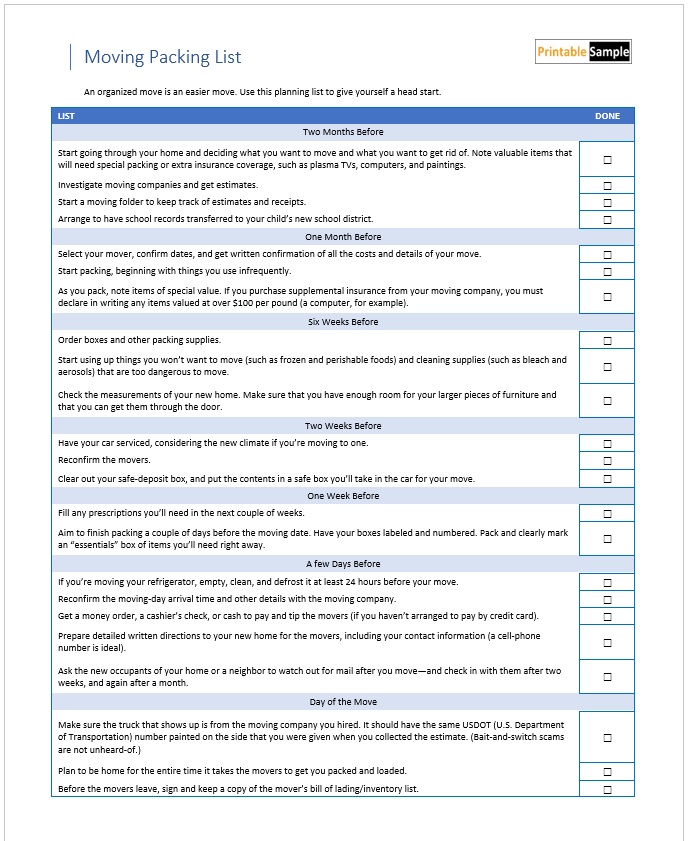
Download Free Packing List Template

Best Practices & Common Mistakes to Avoid
To get the most out of your packing list template, consider these professional tips:
Pro-Tips for Efficiency:
- Use Barcodes: If possible, add barcodes to your template. Scanning an item to mark it as “packed” is significantly faster and more accurate than manual checking.
- Highlight Backorders: If an item is out of stock, clearly mark it as “Backordered” on the packing list. This prevents the customer from thinking you simply forgot the item.
- Go Digital: Transition to “Paperless Packing Slips” by emailing a digital copy to the customer the moment the shipment leaves your dock.
Pitfalls to Avoid:
- Overcomplicating the Layout: Do not clutter the document with marketing fluff. The packing list is a functional tool, not a brochure. Keep it clean and high-contrast.
- Omitting SKU Numbers: Relying solely on product names is a recipe for disaster, especially if you have products that look similar but have different specifications.
- Mixing Invoices and Packing Lists: Avoid putting pricing on a packing list. If the shipment is a gift or going to a third-party receiver, pricing information can cause privacy issues or confusion.
Frequently Asked Questions about Packing List Templates
What is the main difference between a packing list and a bill of lading?
While both are shipping documents, they serve different purposes. A packing list template details the specific contents of the package (what is inside), whereas a Bill of Lading (BoL) is a legal contract between the shipper and the carrier that outlines the terms of transport, ownership, and destination.
Do I need a separate packing list for every box in a multi-box shipment?
Yes. Each individual box should have its own packing list specifying exactly what is in that specific box, as well as a notation of the total number of boxes in the shipment (e.g., “Box 2 of 5”). This ensures that if one box is lost in transit, the customer knows exactly which items are missing.
Can a packing list template be used for international customs?
Absolutely. In fact, it is essential. For international shipping, your packing list should be more detailed, often including the country of origin for each item, the harmonized system (HS) codes, and the net/gross weight of the shipment to facilitate smooth customs clearance.
Should I include pricing on my packing list?
Generally, no. The purpose of a packing list is inventory verification, not billing. Pricing should be reserved for the Commercial Invoice. Keeping pricing off the packing list prevents errors in the receiving department and protects pricing confidentiality if the package is handled by multiple intermediaries.
Conclusion: Start Organizing Your Logistics Today
A well-implemented packing list template is the difference between a chaotic shipping process and a professional supply chain. By prioritizing accuracy, transparency, and standardization, you protect your bottom line and enhance your customer experience. Don’t leave your shipping accuracy to chance—download or build your professional template today and bring a new level of precision to your logistics.