Owning a vehicle is one of the most significant financial investments most people make, yet far too many drivers treat car care as a reactive process—fixing things only after they break. The mental load of remembering when you last rotated your tires, changed your cabin air filter, or flushed your coolant is overwhelming. This is where a car maintenance list template becomes an indispensable tool. Rather than relying on a glovebox full of crumpled receipts or a vague memory of a dashboard light, a structured template transforms vehicle ownership from a guessing game into a precision science, ensuring your car remains safe, efficient, and high in resale value.
The Deep Dive: Why a Structured Maintenance Record Matters
At first glance, a car maintenance list template might seem like a simple checklist. However, its true value lies in preventative asset management. When you track every fluid change and belt replacement, you are effectively creating a “medical record” for your machine. This systematic approach provides three critical advantages that go beyond simple organization.
1. Financial Preservation and Resale Value: A documented history of maintenance is the most powerful tool you have when selling a used car. A buyer is far more likely to pay a premium price if you can present a comprehensive log proving the vehicle was meticulously maintained. It removes the “risk factor” for the buyer and proves the car hasn’t been neglected.
2. Safety and Risk Mitigation: Many critical failures—such as brake pad wear or timing belt snaps—don’t always give a loud warning before they happen. A template forces you to adhere to the manufacturer’s suggested intervals, catching wear-and-tear items before they become catastrophic failures on a highway.
3. Optimized Performance and Efficiency: Engines that are regularly tuned and fluids that are kept clean operate at peak thermal and mechanical efficiency. This directly translates to better fuel economy and a smoother ride, saving you money at the pump and reducing the frequency of expensive, unplanned repairs.
Anatomy of a Perfect Car Maintenance List Template
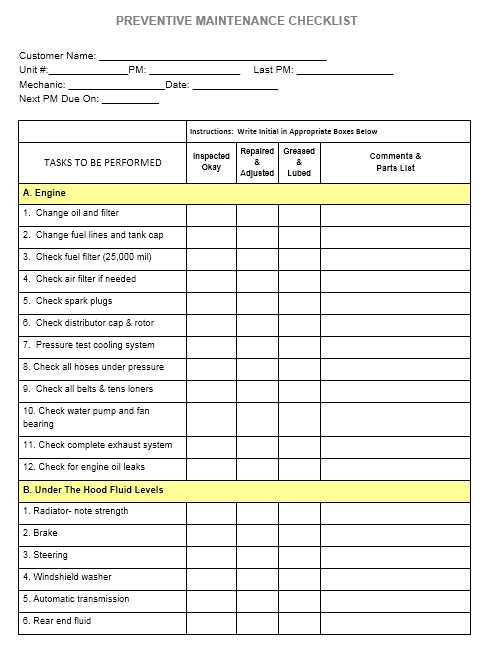
Not all checklists are created equal. A generic piece of paper is not enough; a high-functioning car maintenance list template must be categorized by frequency and urgency. To be truly effective, your template should be divided into the following core sections:
Vehicle Identification Header
- Year, Make, and Model: Essential for tracking part compatibility.
- VIN (Vehicle Identification Number): Crucial for ordering exact replacement parts.
- License Plate Number: Helpful for households with multiple vehicles.
The Service Tracking Log (The Core Grid)
This section should be a table consisting of the following columns to ensure a complete audit trail:
- Date of Service: Exactly when the work was performed.
- Mileage: The odometer reading at the time of service (critical for interval tracking).
- Service Performed: A clear description (e.g., “Full Synthetic Oil Change & Filter”).
- Service Provider: Whether it was done by a certified dealership, a local mechanic, or DIY.
- Cost: To track the total cost of ownership over time.
- Next Due Date/Mileage: The projected point for the next repeat of this service.
The Maintenance Category Checklist
Your template should separate tasks into logical intervals so you aren’t overwhelmed:
- Monthly/Routine: Tire pressure checks, windshield wiper fluid levels, and light bulb inspections.
- Short-Term (Every 3k–7k Miles): Oil and filter changes, tire rotations, and brake fluid checks.
- Mid-Term (Every 15k–30k Miles): Engine air filters, cabin filters, and brake pad inspections.
- Long-Term (Every 60k–100k Miles): Spark plug replacement, timing belt/chain inspection, and transmission fluid flushes.
Download Free Car Maintenance List Template

Step-by-Step Guide: How to Customize and Use Your Template
Implementing a car maintenance list template is only effective if it becomes a habit. Follow this chronological workflow to integrate vehicle tracking into your lifestyle:
- Audit Your Current Status: Start by gathering all existing receipts and invoices. If you have no records, take the car for a “baseline inspection” at a trusted mechanic. Use their report to fill in the current state of your vehicle in the template.
- Consult Your Owner’s Manual: Every car is different. Look at the “Maintenance Schedule” section of your manual. Transfer those specific manufacturer recommendations (e.g., “Change coolant every 50,000 miles”) directly into your template.
- Choose Your Format: Decide if you prefer a digital spreadsheet (Google Sheets/Excel) for automatic calculations and reminders, or a printable PDF kept in a dedicated vehicle binder. Digital is better for backups; physical is better for quick access in the garage.
- Set Trigger Alerts: If using a digital template, set calendar reminders for the “Next Due” dates. If using a physical one, place a reminder sticker on the top left of your windshield.
- The “Immediate Log” Habit: The biggest mistake is waiting until the end of the month to log service. Make it a rule to update your car maintenance list template before you even leave the mechanic’s parking lot.
Best Practices & Common Mistakes to Avoid
To get the most out of your tracking system, consider these professional tips:
- Digital Redundancy: If you use a physical log, take a photo of the page every few months. Fire or vehicle theft can wipe out your entire service history; a cloud backup ensures you keep that “proof of value” for the future.
- Avoid “Over-Maintenance”: While it’s tempting to change oil every 2,000 miles, doing so can be a waste of money and resources. Stick to the intervals in your template based on the manufacturer’s guidelines.
- Detail the “Why”: When logging a repair, don’t just write “Brakes.” Write “Front brake pads replaced due to 3mm wear.” This level of detail helps you identify if a specific part is failing prematurely.
- Don’t Ignore the “Small Stuff”: Many people only track oil. Ensure your template includes tires, wipers, and filters. These “small” items significantly impact fuel efficiency and safety.
Frequently Asked Questions About Car Maintenance Tracking
How often should I update my car maintenance list template?
Your template should be updated immediately following any service. Whether it is a simple DIY windshield wiper replacement or a major engine overhaul, logging the date and mileage instantly prevents the “memory gap” that leads to missed services in the future.
Can I use a digital car maintenance list template for a fleet of vehicles?
Yes. In fact, digital templates are superior for fleet management. By creating a separate tab or sheet for each VIN, you can track the cumulative cost of ownership across all vehicles and identify which models are more expensive to maintain over time.
What is the difference between a maintenance checklist and a maintenance log?
A checklist is a proactive tool (a list of things that need to be done), whereas a log is a reactive record (a list of things that have been done). A comprehensive car maintenance list template combines both: it tells you what is coming up and provides a historical record of completed work.
Is it necessary to track DIY repairs in the template?
Absolutely. If you perform the work yourself, you may not have a professional invoice. Your template serves as the primary evidence that the work was completed. Be sure to note the brand of parts used (e.g., “Bosch Spark Plugs”) to maintain a professional record for future buyers.
Conclusion & Next Steps
A car maintenance list template is more than just a document; it is an insurance policy for your vehicle’s future. By shifting from a reactive mindset to a preventative one, you save money, increase safety, and protect your investment. Don’t wait for a warning light to appear on your dashboard. Download or create your template today, audit your vehicle’s current needs, and start building a history of excellence for your car.