Whether you are managing a sprawling industrial facility, a fleet of company vehicles, or a residential rental portfolio, there is one universal truth: things break. The difference between a minor inconvenience and a catastrophic operational failure is often a single piece of paper—or a digital spreadsheet. This is where a comprehensive maintenance list template becomes your most valuable operational asset.
At its core, a maintenance list template is more than just a checklist; it is a strategic roadmap for asset preservation. It transforms your approach from reactive (fixing things after they break) to proactive (preventing failure before it occurs). By systematizing your upkeep routines, you eliminate the “mental load” of remembering when a filter was last changed or a boiler was inspected, ensuring that nothing falls through the cracks of a busy workday.
The Hidden Value: Why a Maintenance List Template is Non-Negotiable
Many managers view maintenance as a cost center—an expense to be minimized. However, seasoned operators know that a rigorous maintenance strategy is actually a profit-protection mechanism. The “hidden value” of utilizing a structured template manifests in three critical areas: financial predictability, safety compliance, and asset longevity.
1. Eliminating the “Crisis Premium”: When a critical piece of equipment fails unexpectedly, the cost is never just the price of the repair. You pay a “crisis premium,” which includes emergency technician call-out fees, lost production revenue, and expedited shipping for parts. A maintenance list template allows you to schedule interventions during planned downtime, slashing these emergency costs.
2. Creating an Immutable Audit Trail: In many industries, maintenance isn’t just a good idea—it’s a legal requirement. Whether it’s OSHA standards in the US or health and safety regulations in the UK, having a documented history of upkeep is your primary defense during an audit or legal dispute. A template provides a chronological record of due diligence, proving that you took every reasonable step to ensure equipment safety.
3. Combatting Asset Depreciation: Equipment that is ignored degrades exponentially faster than equipment that is maintained. By consistently following a maintenance list template, you maximize the ROI of your capital expenditures, pushing the replacement date of expensive machinery back by years.
Anatomy of a Perfect Maintenance List Template
Not all templates are created equal. A simple “To-Do” list is insufficient for professional asset management. To be truly effective, your maintenance list template must capture specific data points that allow for analysis and accountability. Here are the essential components every high-quality template should include:
- Asset Identification: A unique ID or serial number for the piece of equipment. Generic terms like “Air Conditioner” are insufficient; use “HVAC-Unit-04-NorthWing.”
- Maintenance Frequency: Clearly defined intervals (e.g., Daily, Weekly, Monthly, Quarterly, Annually). This prevents “maintenance creep” where tasks are skipped because the timing is ambiguous.
- Specific Action Item: A clear, verb-driven instruction. Instead of “Check Oil,” use “Check oil level and top up with synthetic 5W-30 if below minimum line.”
- Priority Level: A categorization system (High/Medium/Low) or a criticality score. This helps teams prioritize tasks when resources are limited.
- Assigned Personnel: A designated field for who is responsible for the task, ensuring individual accountability.
- Status Tracking: A way to mark the task as “Pending,” “In Progress,” or “Completed.”
- Date of Completion & Signature: A timestamp and verification mark to validate that the work was actually performed.
- Observations/Notes Field: A space to record anomalies. (e.g., “Noticed slight vibration in belt; may need replacement next month”). This turns a checklist into a diagnostic tool.
Download Free Maintenance List Template
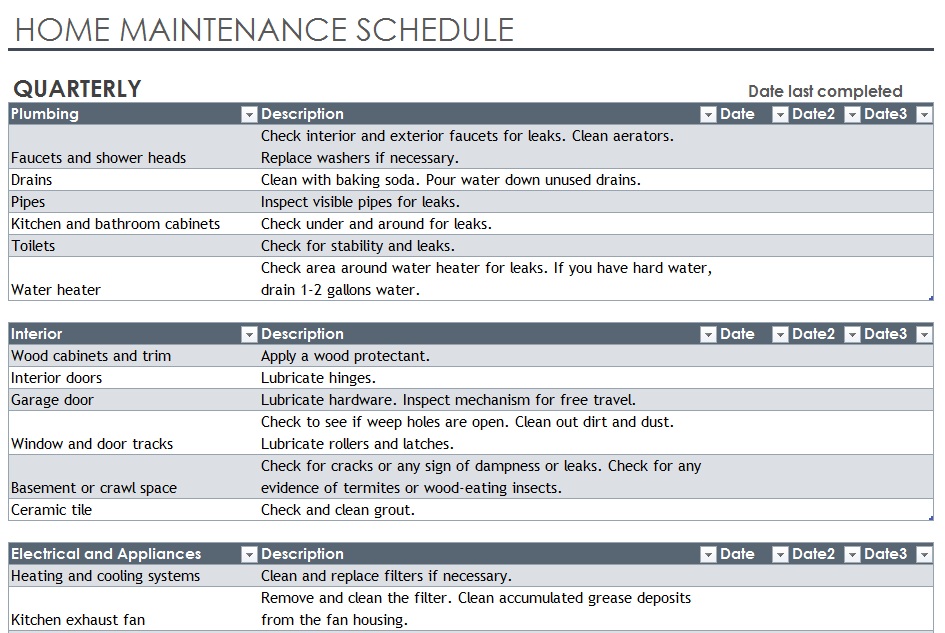

Step-by-Step Guide: How to Customize and Implement Your Template
Simply downloading a template is not enough; you must integrate it into your organizational culture. Follow this chronological workflow to move from a blank document to a fully operational maintenance system.
Step 1: Asset Inventory & Categorization
Before filling out your maintenance list template, conduct a full audit of your assets. Group them by type or location. For example, separate your “Facility Infrastructure” (plumbing, electrical) from your “Production Machinery” (lathes, CNC machines). This allows you to create specialized templates for different categories of equipment.
Step 2: Define the “Criticality Matrix”
Consult the manufacturer’s manuals for every piece of equipment. Extract the recommended service intervals. If the manual suggests a filter change every 3,000 miles, that becomes your baseline. If you operate in a harsh environment (e.g., high dust or extreme heat), adjust these intervals to be more frequent.
Step 3: Assign Ownership and Cadence
Determine who is responsible for which task. High-frequency tasks (daily checks) are usually assigned to on-site operators, while low-frequency, high-complexity tasks (annual certifications) are assigned to external specialists. Map these roles directly into your template.
Step 4: Execution and Review Cycle
Implement a “Review and Refine” period. For the first 90 days, treat your template as a living document. If you find that a weekly task is unnecessary because the equipment never shows wear, move it to monthly. Conversely, if a component is failing between quarterly checks, increase the frequency. This optimization ensures your template is lean and efficient.
Best Practices and Common Pitfalls to Avoid
To get the most out of your maintenance system, consider these professional tips:
Pro-Tips for Efficiency:
- Go Digital: While printable PDFs are great for the shop floor, a cloud-based maintenance list template (via Google Sheets, Airtable, or specialized CMMS software) allows for real-time updates and automatic reminders.
- Use Visual Aids: For complex machinery, attach a photo of the specific valve or switch that needs checking directly to the digital template. This removes guesswork for new employees.
- Bundle Tasks: Group tasks by location. If a technician is already in the basement for the water heater, ensure the template prompts them to check the sump pump and water softener at the same time.
Common Mistakes to Avoid:
- Over-Engineering: Avoid adding 50 columns of data if you only need five. If the template is too tedious to fill out, your staff will start “pencil-whipping” (marking everything as done without actually checking).
- Ignoring the “Notes” Section: The most valuable data is often found in the margins. If a technician notes a “strange noise” three months in a row, that is a signal of imminent failure that a simple “Checkmark” would miss.
- Set-and-Forget Mentality: A template created in 2018 is likely obsolete by 2024. Update your list whenever you purchase new equipment or change your operational volume.
Frequently Asked Questions (FAQs)
How often should I update my maintenance list template?
Your core maintenance list template should be reviewed annually. However, you should update it immediately whenever you install new equipment, replace a major component with a different brand, or notice a recurring failure pattern that suggests the current maintenance interval is insufficient.
What is the difference between a preventive maintenance list and a predictive one?
A preventive list is calendar-based (e.g., “Change oil every 30 days”). A predictive list is condition-based (e.g., “Change oil when the sensor indicates viscosity has dropped”). A high-quality template can accommodate both, using the preventive list as a safety net and the predictive notes to trigger early action.
Can a maintenance list template be used for home maintenance?
Absolutely. While the terminology differs from industrial settings, the logic is the same. A home-based maintenance list template would track things like HVAC filter changes, gutter cleaning, smoke detector battery replacement, and winterizing pipes, preventing expensive home repairs through simple, scheduled tasks.
Should I use a physical paper log or a digital spreadsheet?
The best approach is often a hybrid. Use a digital template as the “Master Record” for scheduling and archiving, but provide laminated physical checklists on the shop floor for technicians to check off in real-time. Once the physical list is complete, the data should be transcribed into the digital master for long-term tracking.
Conclusion: Take Control of Your Assets Today
Chaos is the enemy of profitability. By implementing a rigorous maintenance list template, you shift your operational posture from a state of constant firefighting to a state of controlled precision. Stop waiting for the next breakdown to tell you something is wrong. Download your template, audit your assets, and start protecting your investment today.