The difference between a student who feels constantly overwhelmed and one who maintains a sense of calm and control often boils down to a single factor: organization. In an era of digital distractions and increasing academic rigor, relying on mental notes to track assignments, exam dates, and reading lists is a recipe for burnout. This is where a study schedule template becomes an essential tool for success.
Whether you are a university student balancing a part-time job, a high schooler preparing for finals, or a professional pursuing a certification, the ability to visualize your time is a superpower. A well-structured study plan does more than just list tasks; it optimizes your cognitive load, reduces anxiety, and ensures that no subject is neglected. By transitioning from a chaotic to-do list to a strategic schedule, you move from reactive studying to proactive learning.
What Is a Study Schedule Template?
A study schedule template is a pre-formatted document—available in digital or printable formats—designed to help learners organize their study hours, academic priorities, and deadlines. Unlike a general calendar, which tracks appointments and events, a study schedule is a specialized productivity tool focused specifically on the allocation of time for deep work and knowledge acquisition.
These templates typically range from simple daily planners to complex monthly grids. They provide a skeletal framework where users can plug in their courses, specific topics to be covered, and designated time blocks. By using a template, learners avoid the “decision fatigue” of figuring out how to organize their day and can instead focus their energy on the actual material they need to master.
Purpose and Importance
The primary purpose of a study schedule is to bridge the gap between intention and action. Many students have the intention to study “more,” but without a concrete plan, that intention rarely translates into a structured habit. The importance of using a formal template manifests in several critical areas:
- Combatting Procrastination: By breaking a massive textbook or a complex project into small, manageable time slots, the task becomes less intimidating.
- Preventing “Cramming”: A template encourages distributed practice (spaced repetition), which is scientifically proven to be more effective for long-term retention than marathon sessions the night before an exam.
- Balancing Life and Academics: It allows users to visually carve out time for sleep, exercise, and socialization, ensuring that academic pursuit doesn’t lead to total burnout.
- Accountability: Having a written record of what needs to be achieved creates a psychological contract with oneself, increasing the likelihood of task completion.
Key Elements Included
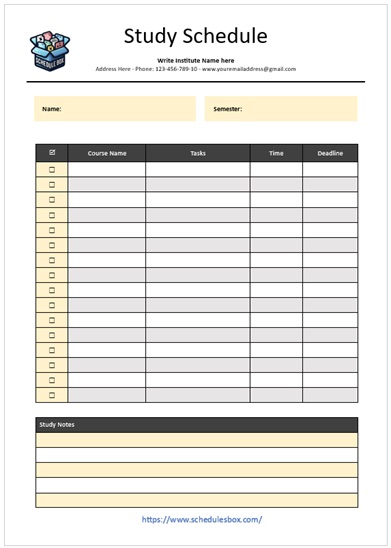
While templates vary based on the user’s needs, a comprehensive study schedule template generally includes the following essential components:
1. Time Blocks (Daily/Weekly Grid)
The core of the template is the temporal grid. This allows users to assign specific hours of the day to specific subjects. Effective templates often use “time-blocking,” where chunks of 90 to 120 minutes are dedicated to a single subject to facilitate deep focus.
2. Subject Priority List
Not all subjects are created equal. A high-quality template often includes a section to rank subjects by difficulty or urgency, ensuring that the most challenging material is tackled when the user’s energy levels are highest (typically in the morning).
3. Specific Learning Objectives
Instead of simply writing “Study Biology,” a professional template encourages users to write “Review Chapter 4: Cellular Respiration.” This level of specificity makes the schedule actionable.
4. Break Intervals
Incorporating planned breaks (such as those found in the Pomodoro Technique) is crucial. Templates that include dedicated “rest” or “buffer” zones prevent mental fatigue.
5. Deadline and Milestone Tracker
A dedicated space for exam dates, essay due dates, and project milestones keeps the “big picture” in view while managing the daily grind.
6. Progress Checklist
Visual cues, such as checkboxes or progress bars, provide a sense of accomplishment and motivation as tasks are completed.
Download this Free Study Schedule Template

Benefits of Using a Template
Choosing a structured template over a blank piece of paper offers several strategic advantages:
- Significant Time Savings: You no longer spend 30 minutes every morning deciding what to study. The decision has already been made; you simply execute the plan.
- Consistency and Routine: Templates help establish a circadian rhythm for studying. When you study at the same time every day, your brain begins to prime itself for focus as that time approaches.
- Enhanced Accuracy: By listing all requirements in one place, you reduce the risk of overlooking a minor assignment or missing a deadline.
- Professional Organization: For those in higher education or professional certifications, using a structured template mimics the project management skills required in the corporate world.
- Mental Clarity: “Externalizing” your schedule—moving it from your head to a document—frees up cognitive bandwidth, reducing the stress and anxiety associated with academic pressure.
Who Can Use This Template?
The versatility of a study schedule template makes it applicable to a wide array of users:
- High School Students: To manage the transition from guided classroom learning to independent homework and test preparation.
- University and College Students: To navigate complex semester loads, varying credit hours, and the independence of campus life.
- Graduate Students and PhD Candidates: To organize extensive research, dissertation writing, and comprehensive exam reviews.
- Professional Certification Candidates: For those studying for the CPA, Bar Exam, MCAT, or PMP, where high-stakes testing requires a rigorous, multi-month plan.
- Lifelong Learners: Individuals taking online courses (Coursera, Udemy) or teaching themselves a new language or skill.
- Homeschooled Students: To provide structure and a sense of school-day rhythm within a home environment.
How to Customize the Template
A template is a starting point, not a rigid rulebook. To make a study schedule template truly effective, you must personalize it to fit your biological and academic needs. Here is how to do it effectively:
- Identify Your Peak Energy Windows: Are you a morning lark or a night owl? Place your most difficult subjects (the “heavy lifting”) during your peak alertness and lighter tasks (reviewing notes, organizing folders) during your energy slumps.
- Apply the 80/20 Rule (Pareto Principle): Identify the 20% of the material that will likely yield 80% of the results on the exam. Allocate more time blocks to these high-impact areas.
- Build in “Buffer Time”: Life happens. A rigid schedule that breaks upon the first unexpected phone call is useless. Leave 30-60 minutes of “flex time” each day to catch up on tasks that took longer than expected.
- Color-Code by Subject: Use different colors for different classes. This allows you to see at a glance if your week is balanced or if you are accidentally spending 90% of your time on one subject while neglecting others.
- Digital vs. Analog: Decide if you prefer a printable PDF for handwriting (which can improve memory) or a digital spreadsheet/app for easy editing and syncing across devices.
Common Mistakes to Avoid
Even with a great template, poor planning can lead to failure. Avoid these common pitfalls:
- Over-Scheduling: The most common error is filling every minute of the day. An unrealistic schedule leads to guilt and abandonment when you inevitably fall behind. Be realistic about your capacity.
- Ignoring Physical Needs: Forgetting to schedule time for meals, sleep, and hydration. A brain that is starved of sleep cannot retain information, regardless of how perfect the schedule is.
- Lack of Flexibility: Treating the schedule as a prison rather than a guide. If a concept is taking longer to grasp, it is okay to shift the schedule. The goal is mastery, not just checking a box.
- Underestimating Task Duration: Many users fall victim to the “Planning Fallacy,” believing a chapter will take one hour when it actually takes three. Always add a small time cushion to complex tasks.
- Focusing on “Time Spent” rather than “Results”: Avoid the trap of thinking that sitting at a desk for five hours equals five hours of studying. Focus on active recall and output rather than just “time spent reading.”
Related Templates and Documents
To build a complete academic ecosystem, consider pairing your study schedule template with these complementary resources:
- Assignment Tracker: A specialized list to track due dates, submission formats, and grading weights.
- Cornell Note-Taking Template: A structured way to capture information during lectures that feeds directly into your study blocks.
- Reading Log: A document to track chapters read, key takeaways, and questions for the professor.
- Exam Revision Checklist: A granular list of every topic that could appear on a test, used to “tick off” areas of confidence.
- Daily Habit Tracker: To monitor sleep, water intake, and exercise, ensuring the physical foundation for mental performance is solid.
Frequently Asked Questions (FAQ)
How often should I update my study schedule?
While you should have a monthly overview, it is best to review and adjust your study schedule template weekly. Every Sunday, evaluate what you achieved the previous week and adjust the upcoming week’s goals based on your current progress and any new assignments.
Is a digital study schedule better than a printed one?
It depends on your learning style. Digital schedules offer flexibility, reminders, and easy editing. However, printable templates are often better for those who get distracted by phone notifications or those who find the tactile act of writing helps them remember information.
What is the best way to handle an unexpected interruption in my schedule?
The best approach is to use “Buffer Blocks.” If an emergency arises, don’t try to squeeze everything into the remaining hours. Move the missed tasks into your designated buffer time or shift them to the next day, ensuring you don’t sacrifice sleep to make up for it.
How do I decide how much time to allocate to each subject?
Use a combination of the course’s credit value and your personal proficiency. A subject you find difficult requires more time blocks than one you find intuitive, even if the credit hours are the same.
Can I use a study schedule template if I have a full-time job?
Absolutely. In fact, it is even more critical. Focus on “micro-studying” during commutes or lunch breaks and dedicate larger blocks on weekends. A template helps you protect your limited study time from being encroached upon by other chores.
Conclusion
Success in any academic endeavor is rarely a matter of raw intelligence alone; it is a matter of strategy and consistency. A study schedule template is more than just a grid of hours—it is a roadmap to your goals. By transforming a vague desire to “study more” into a precise, actionable plan, you eliminate the friction that leads to procrastination and stress.
Whether you choose a minimalist daily layout or a comprehensive semester-long planner, the key is to start today. Customize your template, be honest about your time constraints, and remain flexible as you progress. With a structured approach to your learning, you can achieve higher grades, retain information longer, and maintain a healthier work-life balance.