We have all experienced the “productivity paradox”: a day where you are incredibly busy from sunrise to sunset, yet by 6:00 PM, you realize you didn’t actually accomplish any of your most important goals. This happens because there is a fundamental difference between being busy and being productive. The bridge between the two is a structured daily schedule template.
A daily schedule template is more than just a list of chores; it is a strategic blueprint for your day. By externalizing your intentions into a visual framework, you eliminate decision fatigue—the mental exhaustion that comes from constantly deciding what to do next. Whether you are a corporate executive managing a team, a freelancer juggling multiple clients, or a student balancing academics, a rigorous approach to scheduling is the most effective way to reclaim your time and reduce stress.
The Deep Dive: Why a Daily Schedule Template is Non-Negotiable for Success
Many people rely on a simple “to-do list,” but lists are inherently flawed because they lack the dimension of time. A list tells you what to do, but it doesn’t tell you when to do it or how long it will take. This often leads to “over-planning,” where you list twenty tasks but only have the capacity for five, resulting in a cycle of guilt and burnout.
Implementing a formal daily schedule template introduces three critical psychological advantages:
- The Power of Time Blocking: When you assign a specific block of time to a task, you create a psychological commitment. This transforms a vague intention (“I need to write that report”) into a concrete appointment (“I will write the report from 9:00 AM to 11:00 AM”).
- Elimination of Decision Fatigue: Every time you ask yourself, “What should I do now?” you consume mental energy. A template automates this process, allowing you to preserve your willpower for the actual work.
- Enhanced Accountability: A schedule acts as a mirror. When you consistently miss a specific block of time, it provides immediate data that you are either overestimating your capacity or procrastinating on a specific type of task.
Without this structure, you are essentially operating in a reactive mode—responding to emails, notifications, and other people’s emergencies rather than proactively driving your own agenda. The risk isn’t just lower productivity; it’s the gradual erosion of your work-life balance as professional tasks bleed into your personal recovery time.
Anatomy of a Perfect Daily Schedule Template
Not all templates are created equal. A generic grid of hours is rarely enough to sustain long-term productivity. To build or select a high-performance daily schedule template, you must ensure it contains these core components:
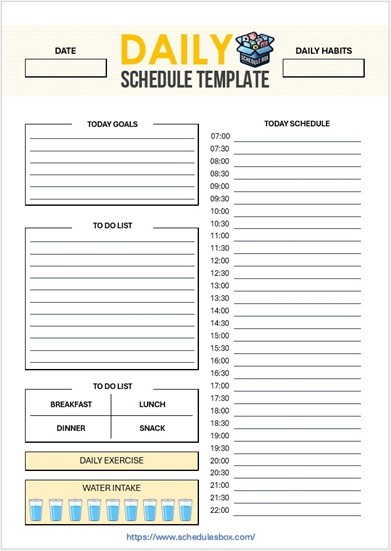
- The Time Grid (Hourly/Half-Hourly): The backbone of the document. This should span from your wake-up time to your wind-down time, allowing you to visualize the finite nature of your day.
- The “Top 3” Priority Section: A dedicated space at the top to list the three non-negotiable tasks for the day. This ensures that even if the day becomes chaotic, the most impactful work is identified.
- Time Blocks for Deep Work: Clearly demarcated sections for high-concentration tasks. Deep work blocks should typically be 90 to 120 minutes long to allow for a state of “flow.”
- Administrative/Shallow Work Slots: Designated times for emails, phone calls, and quick admin tasks. Separating these from deep work prevents the “fragmentation” of your attention.
- Buffer Zones (The “White Space”): Strategic 15-to-30 minute gaps between major tasks. These account for travel, bathroom breaks, or tasks that run over their allotted time.
- Habit Trackers/Wellness Check-ins: Small checkboxes for water intake, exercise, or mindfulness. This integrates health into the schedule, ensuring you don’t sacrifice wellbeing for output.
- The End-of-Day Reflection: A small section to note what was accomplished and what needs to be migrated to tomorrow’s daily schedule template.
Step-by-Step Guide: How to Customize and Use Your Schedule
Having a template is the first step; executing it is where the value lies. Follow this chronological workflow to maximize your efficiency:
Step 1: The “Brain Dump” (The Night Before)
Never start your day by planning your day. The mental effort required to organize is too high for the morning. Instead, spend 10 minutes every evening listing every task on your mind. This clears your mental cache and allows for better sleep.
Step 2: Prioritize Using the Eisenhower Matrix
Categorize your brain-dumped list into: Urgent & Important, Important but Not Urgent, and Urgent but Not Important. Your “Top 3” priorities should come exclusively from the “Important” categories.
Step 3: Map the Big Rocks First
Place your most difficult, high-value tasks (the “Big Rocks”) into your daily schedule template first. Schedule these during your peak energy levels—usually the first few hours after waking up. This is known as “eating the frog.”
Step 4: Fill the Gaps with “Pebbles”
Once your deep work is scheduled, fill the remaining gaps with smaller tasks (the “pebbles”) like emails, scheduling meetings, or quick chores. Group these into “batches” to avoid switching contexts too often.
Step 5: Real-Time Adjustment
Treat your schedule as a guide, not a prison. If an emergency arises, don’t abandon the template. Simply shift your blocks forward or move a lower-priority task to the next day. The goal is resilience, not perfection.
Download Free Daily Schedule Template

Best Practices & Common Mistakes to Avoid
To get the most out of your daily schedule template, consider these professional tips:
Pro-Tips for Success:
- Digital vs. Analog: Use a digital template (Google Calendar, Notion) for flexibility and reminders, but keep a physical printed copy on your desk for high-visibility focus.
- Color Coding: Assign colors to different categories (e.g., Blue for Client Work, Green for Personal, Red for Urgent). This allows you to see at a glance if your day is balanced.
- The 20% Rule: Leave roughly 20% of your day unscheduled. Life happens; having a buffer prevents a single delay from ruining your entire day.
Common Pitfalls to Avoid:
- Over-Scheduling: The biggest mistake is filling every single minute. This creates anxiety and leads to failure the moment a task takes longer than expected.
- Ignoring Energy Cycles: Don’t schedule a complex analytical task for 3:00 PM if you typically experience a mid-afternoon energy crash.
- The “To-Do List” Trap: Avoid simply listing tasks in the template without assigning them a specific time slot. A list without a time is just a wish.
Frequently Asked Questions About Daily Scheduling
What is the difference between a to-do list and a daily schedule template?
A to-do list is a comprehensive inventory of tasks that need completion, regardless of when they happen. A daily schedule template is a time-bound plan that assigns those tasks to specific hours of the day. While the list tells you what is on your plate, the schedule tells you how you will actually execute those tasks within the constraints of 24 hours.
How do I handle unexpected interruptions in my schedule?
The key is to build “buffer blocks” into your daily schedule template. If an interruption occurs, use your buffer time to absorb the delay. If the interruption is major, use the “shift and prune” method: move the remaining blocks down and delete or reschedule the lowest-priority task of the day to make room.
Is a digital or paper daily schedule template more effective?
Neither is objectively superior; it depends on your cognitive style. Digital templates offer superior synchronization, easy editing, and reminders. Paper templates provide fewer distractions, better tactile memory, and a physical sense of satisfaction when crossing off a task. Many high-performers use a “hybrid” system: digital for long-term planning and paper for daily execution.
How do I prioritize tasks within my daily schedule?
Use the “Rule of Three.” Identify the three tasks that, if completed, would make the day a success regardless of anything else. These are your primary anchors. Once these are scheduled into your daily schedule template, all other tasks are secondary. This prevents you from feeling overwhelmed by a long list and keeps you focused on high-impact results.
Conclusion: Take Control of Your Day
Time is the only resource you cannot buy back. By implementing a structured daily schedule template, you stop letting the day happen to you and start making the day happen for you. Whether you start with a simple piece of paper or a complex digital system, the act of intentional planning is the first step toward a more productive, less stressful life. Download your template, block your time, and start executing today.